

Table of Contents
A music studio can do much more than provide a room where you record songs. The right studio can become an important part of your career development by helping you improve your sound, develop your artistic identity, collaborate with other professionals, create release-ready music, and build relationships within the music industry.
For independent artists especially, the studio is often one of the first places where the creative and business sides of a music career come together.
However, simply spending money on studio sessions does not automatically make an artist successful. A studio becomes valuable when you use it strategically—as a place to develop your music, build professional relationships, create quality content and prepare projects for release.
Berklee notes that professional recording careers involve much more than recording itself, including collaboration, production, recording, marketing, touring and other career skills. (Berklee Online)
So, how can a music studio help grow your music career?
Let’s look at the practical ways.
1. A Music Studio Helps You Create Professional-Quality Music
One of the most obvious ways a studio can help your career is by improving the quality of your recordings.
A good song can lose its impact when it is poorly recorded, badly edited or inadequately mixed. Problems such as background noise, inconsistent vocals, excessive distortion, poor microphone technique and an unbalanced mix can make it difficult for listeners to appreciate the music.
A professional studio can provide:
- Quality microphones and recording equipment
- Acoustic treatment and controlled monitoring
- Experienced recording engineers
- Professional vocal recording techniques
- Editing and vocal comping
- Music production
- Mixing and mastering
- Proper file preparation for release
This does not mean that expensive equipment automatically produces successful music. The performance, songwriting, production decisions and artistic direction still matter.
The real advantage is having the technical environment and expertise to translate your creative idea into a professional recording.
Berklee’s independent recording and production curriculum similarly emphasizes recording, editing, mixing, mastering, quality control, file management and preparing commercially competitive masters for labels and streaming platforms. (Berklee College of Music)
If you already have a song or instrumental and primarily need professional recording, a dedicated session recording service can be a practical starting point.
2. The Studio Can Help You Develop Your Sound
Artists often focus on recording songs without spending enough time developing a recognizable musical identity.
A studio can become a laboratory for experimentation.
You can test different:
- Vocal styles
- Harmonies
- Ad-libs
- Tempos
- Instrument choices
- Production styles
- Song structures
- Vocal effects
- Genres and subgenres
For example, an Afrobeats artist might discover that their strongest songs combine melodic vocals with a particular type of percussion and atmospheric production. A producer can help the artist experiment until that sound becomes more consistent.
This is particularly valuable for emerging musicians because your early recordings can help you discover what makes your music different.
A studio should therefore not simply ask, “How do you want this song recorded?”
A good creative team should also be asking:
“What should make this artist’s music recognizable?”
3. Producers Can Help Turn Ideas Into Complete Songs
Many artists have melodies, lyrics or rough voice notes but struggle to transform those ideas into finished records.
This is where a producer can become extremely important.
A producer may help with:
- Beat selection
- Chord progressions
- Song arrangement
- Tempo
- Instrumentation
- Vocal arrangement
- Harmonies
- Transitions
- Intros and outros
- Song structure
- Overall sonic direction
For example, an artist may arrive with a chorus and two verses. The producer can help determine whether the song needs an intro, pre-chorus, bridge, instrumental break or additional vocal layers.
The result is not simply a recorded demo. It becomes a properly developed musical production.
If you need this level of assistance, consider a full music production service rather than booking recording time alone.
4. A Studio Can Help You Become a Better Recording Artist
Recording regularly can improve your technical and artistic abilities.
You begin to understand:
- How to work with microphones
- How to control your breathing
- How to maintain consistent vocal distance
- How to deliver different emotions
- How to record doubles
- How to use harmonies
- How to perform ad-libs
- How to take direction
- How to work efficiently during sessions
These skills become increasingly important as your career develops.
Professional studio sessions also teach you how to work under time and budget constraints. That matters because professional recording environments often require musicians to prepare properly and make decisions efficiently.
For example, a vocalist who spends three hours trying to find the right vocal take for one verse may eventually discover that better preparation, vocal practice and knowledge of the song can reduce recording time considerably.
5. Studios Can Connect You With Other Music Professionals
One of the most overlooked benefits of a good studio is networking.
A studio can bring together:
- Artists
- Producers
- Songwriters
- Engineers
- Session musicians
- DJs
- Photographers
- Videographers
- Managers
- Promoters
- Other creative professionals
That creates opportunities for collaboration.
Berklee’s guidance on music careers repeatedly emphasizes the importance of professional relationships and collaboration. Its information on session musicians, for example, notes that career development is strongly connected to reputation and relationships with artists, producers and other musicians. (Berklee)
This is one reason artists should treat every studio session professionally.
Be punctual. Communicate clearly. Respect the engineer. Pay what you agreed to pay. Give collaborators proper credit. Keep your promises.
The person you meet during a recording session today could become your producer, songwriter, manager, session musician or business partner tomorrow.
6. A Studio Can Help With Artist Development
Some studios provide more than recording and mixing.
They may offer artist development, helping musicians think about the bigger picture of their careers.
Artist development can include discussions about:
- Musical identity
- Target audience
- Song selection
- Release strategy
- Branding
- Content creation
- Performance
- Career goals
- Collaboration
- Professional presentation
This is especially useful for beginners who may know how to sing or make beats but do not yet understand how to build a sustainable music career.
Modern music careers require artists to combine creative ability with business knowledge. Berklee’s current music-business education similarly covers branding, self-promotion, networking, distribution, copyright, publishing, licensing and revenue diversification. (Berklee Online)
If you are looking for guidance beyond recording, an artist development service can be more useful than simply purchasing additional studio hours.
7. Your Studio Can Help You Build a Professional Music Catalogue
Career growth usually requires you to have music that people can actually hear.
Instead of recording randomly, you can use your studio sessions to build a planned catalogue.
For example, an emerging artist could work toward:
Phase 1: Record three strong singles.
Phase 2: Release the strongest single and create promotional content around it.
Phase 3: Study audience response.
Phase 4: Record the next songs based on what the artist is learning.
Phase 5: Build toward an EP or album.
This approach is more strategic than spending money on dozens of unrelated recordings.
A studio can help you create the actual musical assets that support your wider career: singles, EPs, albums, demos, acoustic versions, instrumentals, clean versions and promotional material.
8. Professional Mixing and Mastering Can Make Your Releases More Competitive
Recording a song is only one stage of production.
After recording, the project still needs editing, mixing and mastering.
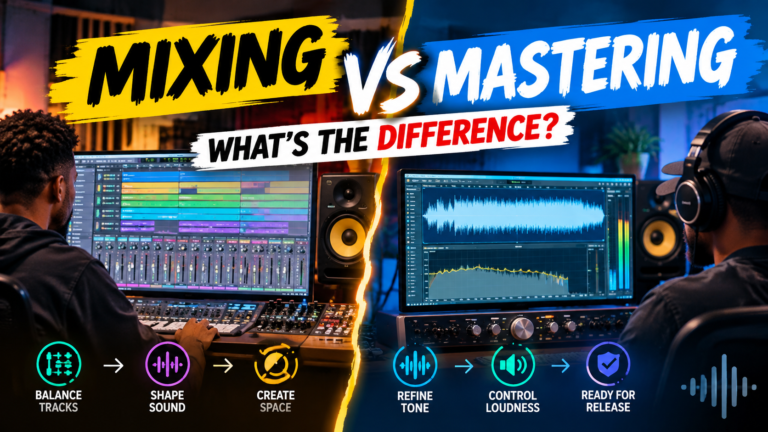
Mixing determines how the individual elements work together. Vocals, drums, bass, instruments and effects need to occupy an appropriate sonic space.
Mastering then prepares the finished mix for distribution and playback across different systems.
Professional mixing and mastering cannot make a poorly written song automatically successful. But poor technical quality can distract listeners from a good song.
This is why independent artists should pay attention to the final stage of production rather than spending their entire budget on recording.
If your production is already complete, you may benefit from a professional mixing and mastering service in Aba.
9. Studios Can Help You Prepare Music for Distribution
Making the song is not the same as releasing the song.
An artist eventually needs to consider:
- Master files
- Artwork
- Metadata
- Artist name
- Song title
- Credits
- Release date
- Distribution
- Promotional materials
- Streaming profiles
This is where a studio or music service provider with broader industry knowledge can be useful.
Independent artists increasingly have access to tools that allow them to record, distribute and promote music without signing immediately to a major record label. Berklee describes this shift toward independent recording and self-release as an important feature of the modern recording industry. (Berklee)
If you need help getting finished music onto digital platforms, you can explore music distribution services.
10. A Studio Can Help You Create Content Around Your Music
Your career is not built only from songs.
You also need attention.
Recording sessions can generate content for:
- TikTok
- YouTube
- X
- Artist websites
For example, while recording a new single, you could capture:
- Behind-the-scenes footage
- Short vocal-session clips
- Producer explanations
- Song previews
- Studio photographs
- Before-and-after production demonstrations
- Artist interviews
- Short performance videos
This turns one recording session into multiple pieces of promotional content.
The important thing is to plan this before the session rather than trying to remember everything afterward.
11. Studios Can Introduce You to Collaboration Opportunities
Collaboration can expose an artist to another artist’s audience and creative network.
Imagine a singer recording at a studio where a producer regularly works with several other artists. A well-organized collaboration could result in:
Artist A + Producer B + Artist C
The resulting record may introduce Artist A to Artist C’s listeners while creating new professional relationships.
But collaborations should be strategic.
Do not collaborate with someone simply because they have more followers. Consider:
- Musical compatibility
- Audience compatibility
- Professional reputation
- Work ethic
- Quality of music
- Long-term potential
The goal is to create something valuable—not merely to attach another person’s name to your song.
12. Your Studio Reputation Can Become Part of Your Professional Network
A studio that has worked with many musicians can become a valuable networking hub.
For example, an artist who consistently records in the same professional environment may gradually develop relationships with engineers, producers and other artists.
That familiarity can lead to referrals.
A producer might recommend a vocalist for another project. A musician might recommend an engineer. An artist might introduce a studio to another artist.
This is one reason reputation matters.
The Music Business Association describes networking and industry relationships as important components of professional development and collaboration across the music business. (musicbiz.org)
13. A Studio Can Help You Avoid Expensive Mistakes
Experience can save money.
For example, an inexperienced artist may:
- Record an unsuitable song
- Choose the wrong key
- Record without a clear arrangement
- Spend too much money on unnecessary sessions
- Release an unfinished mix
- Lose track of instrumental and vocal files
- Forget songwriter or producer credits
- Delay a release because files were not properly prepared
A knowledgeable producer or engineer can identify many of these problems before they become expensive.
This is particularly important for independent artists because they usually have to manage their own recording budgets.
Berklee’s independent production curriculum explicitly includes budgeting, file management, quality control and career strategy, illustrating how technical and business decisions increasingly overlap in independent music production. (Berklee College of Music)
14. But a Music Studio Cannot Build Your Career for You
This is the part many upcoming artists need to understand.
A studio can provide the infrastructure, expertise and creative environment.
It cannot guarantee:
- A hit song
- Viral success
- A record deal
- Millions of streams
- A large fan base
- Successful concerts
- Financial independence
Those outcomes depend on many factors, including songwriting, performance, branding, audience development, marketing, consistency, business decisions, timing and sometimes circumstances outside your control.
Berklee similarly emphasizes that recording artists must do much more than record; performing, promotion, touring and audience development are important parts of a recording career. (Berklee Online)
Think of the studio as one component of your career system, not the entire system.
15. How to Get the Most Career Value From a Music Studio
If you are an independent artist, don’t approach every studio visit as simply “I need to record a song.”
Instead, arrive with a plan.
Before the session
Prepare:
- Lyrics
- Song structure
- Instrumental
- Reference tracks
- Vocal ideas
- Harmonies
- Ad-lib ideas
- Desired recording deadline
- Budget
If possible, rehearse the song before entering the studio.
During the session
Focus on:
- Performance
- Vocal consistency
- Communication
- Creative decisions
- Efficient use of studio time
- Proper file organization
Also ask questions. If you do not understand something about the recording or production process, learn from the engineer.
After the session
Do not immediately forget about the song.
Make sure you have:
- Final mixes
- Mastered files
- Instrumental
- Acapella where appropriate
- Correct credits
- Artwork
- Metadata
- Promotional content
- A release plan
Then move into promotion and audience development.
Common Mistakes Artists Make With Studios
Spending money on recording without a release plan
A professionally recorded song sitting on your computer is not building your career.
Know what happens after the master is finished.
Choosing a studio based only on price
The cheapest studio is not necessarily the most economical option.
If poor recording quality forces you to redo vocals, remix the project or delay the release, the initial saving may disappear.
Expecting the engineer to fix everything
Engineering can improve a performance, but it cannot replace preparation, songwriting or artistic ability.
Recording too many songs without evaluating them
More songs do not automatically mean a stronger career.
Focus on quality and strategic releases.
Ignoring relationships
A studio is a professional environment. Treat the people you meet there with respect.
Failing to keep your project files
Always maintain organized copies of your important recordings, mixes, masters, instrumentals, stems and artwork.
What Should You Look for in a Music Studio?
Before choosing a studio, consider more than the equipment.
Ask:
- Does the studio understand my genre?
- Can I hear examples of previous work?
- Does the engineer understand my artistic direction?
- Is the recording environment suitable?
- What exactly is included in the price?
- How long will the project take?
- Will I receive my project files?
- Does the studio offer mixing and mastering?
- Can they help with production if I need it?
- Do they offer artist-development or release support?
The best studio for you is not necessarily the studio with the most expensive equipment.
It is the studio that can consistently help you achieve the sound and professional outcome you need.
Key Takeaways
A music studio can help grow your music career by providing:
- Professional recording
- Music production
- Mixing and mastering
- Artist development
- Creative feedback
- Collaboration opportunities
- Industry networking
- Professional recording experience
- Content opportunities
- Release preparation
- Career guidance
But the studio is only one part of the equation.
Music career growth happens when quality music, consistent releases, audience development, professional relationships and business strategy work together.
The smartest artists therefore don’t simply ask, “How much does studio recording cost?”
They ask:
“How can I use this studio session to move my career forward?”
That change in mindset can make your studio budget far more valuable.
If you are based in Aba and looking for a studio that combines recording with broader music-production and career-support services, you can explore CFATMUSIC Studios and its available production, recording, mixing, distribution and artist-development services.
Final Thoughts
A music studio can be the place where an artist’s ideas become professional recordings, but its greatest value can extend far beyond the microphone.
The right studio can help you improve your craft, discover your sound, collaborate with other professionals and develop music that is ready for the market.
However, don’t measure your studio investment only by how many songs you record.
Measure it by what each session helps you accomplish.
Did you become a better performer? Did you create a stronger song? Did you develop your sound? Did you meet someone who can contribute to your next project? Did you leave with a release-ready master? Did you create content that can introduce your music to new listeners?
When the answer is yes consistently, the studio is no longer just a place where you record music.
It becomes part of your career-development strategy.