

Table of Contents
If you are planning a studio session, one of the first questions you may ask is: how many songs can I record in one day?
The short answer is: a prepared artist can often record 2–4 songs in a full studio day, while very simple songs may allow 4–5 or more. However, one or two well-recorded songs may be a more realistic target when the music requires layered vocals, harmonies, ad-libs, detailed production, or extensive retakes.
The important thing is that recording more songs does not automatically mean having a more productive session.
A song can take considerably longer when the artist is still writing lyrics, learning melodies, changing the arrangement, building harmonies, or trying to achieve a very specific vocal performance. Professional recording also involves setup, sound checks, multiple takes, comping, editing and decision-making.
So instead of asking only, “How many songs can I record in one day?”, a better question is:
“How many songs can I record properly in the time available?”
That distinction can save you money, protect your voice and give you better recordings.
How Many Songs Can You Record in One Day?
For a typical full-day vocal recording session, these are useful planning ranges:
| Type of recording session | Realistic songs per day |
| Simple demos or straightforward vocals | 4–6 songs |
| Prepared artist over finished beats | 2–4 songs |
| Professionally layered Afrobeats vocals | 1–3 songs |
| Gospel songs with harmonies and backing vocals | 1–2 songs |
| Complex productions requiring live instruments | 1–2 songs |
| Songs still being written or arranged | 1–2 songs |
| Full production from scratch | Usually not several complete songs in one day |
These are planning ranges, not guarantees.
A highly prepared artist who already knows the lyrics, melody, key, tempo and arrangement may move through songs quickly. Another artist could spend several hours on one song because the production is complex or the vocal performance requires many takes.
Professional recording is also different from simply getting a rough vocal onto a beat.
A recent CFATMUSIC Studios guide similarly estimates that a simple vocal recording over a finished instrumental may take around 1–3 hours, while professional vocal recording with multiple takes can take several hours. It also notes that full production, editing, mixing and mastering extend beyond the actual tracking session.
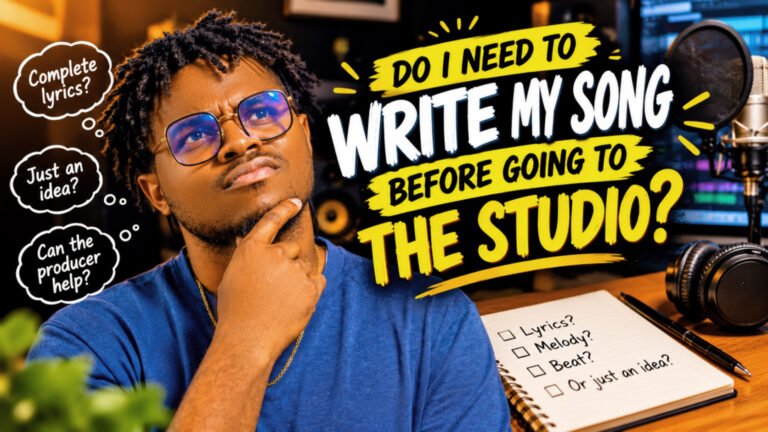
The biggest factor is preparation
The more decisions you make before entering the studio, the fewer decisions you have to make while the clock is running.
A prepared artist should ideally arrive with:
- Finished lyrics
- A rehearsed melody
- The correct instrumental
- A clear song structure
- Knowledge of the key and tempo
- An idea of the desired vocal style
- Reference songs where necessary
- Any planned harmonies or background vocals
This is why pre-production matters so much. Professional producers often spend considerable time preparing arrangements and technical setups before the actual recording begins because better preparation makes the session more efficient and allows the creative team to concentrate on performances rather than solving avoidable problems.
What Determines How Many Songs You Can Record?
1. How prepared is the artist?
This is probably the biggest variable.
Consider two artists booking the same eight-hour session.
Artist A arrives with five completed songs. The lyrics are memorized, the melodies are rehearsed and the beats are already finalized.
Artist B arrives with five song ideas but is still changing lyrics and deciding how to sing each chorus.
They may have booked exactly the same amount of studio time, but their output can be completely different.
Artist A might record several songs.
Artist B might spend most of the day finishing one or two.
This is why trying to write an entire song from scratch inside a paid recording session can quickly become expensive.
There is nothing wrong with creativity happening in the studio. Sometimes the best ideas appear when the microphone is on. But if your objective is to record several songs in one day, writing, arranging and rehearsing should happen before the session whenever possible.
2. The complexity of the song
Not every song requires the same amount of recording.
A straightforward rap song with one lead vocal may be relatively quick.
An Afrobeats song could require:
- Lead vocals
- Vocal doubles
- Harmonies
- Ad-libs
- Call-and-response sections
- Background vocals
- Punch-ins
- Multiple vocal effects
A Gospel production may require even more layers, particularly when the arrangement includes choir parts, harmonies, backing vocals or multiple performers.
A song with live guitar, piano, saxophone or other instruments can also require additional setup and recording time.
The more individual parts you need to capture, the fewer complete songs you should expect to finish in one day.
3. Your recording method
There is a major difference between recording a simple vocal and building a complete production.
With a finished instrumental, the session may focus mainly on the vocal.
With a custom production, the producer may still be:
- Creating or modifying the beat
- Changing the arrangement
- Selecting sounds
- Recording instruments
- Developing harmonies
- Adjusting the song structure
- Testing different vocal approaches
That is no longer simply a “recording session.”
It is a music-production session.
CFATMUSIC Studios’ Full Music Production Service, for example, covers stages such as arrangement, instrumental creation, vocal recording, editing, mixing, mastering and release preparation. Those stages naturally require more time than simply tracking vocals over a finished beat.
4. How many takes do you need?
Some singers walk into the booth and deliver an excellent take quickly.
Others need several attempts before they are comfortable with the performance.
Neither approach is automatically better.
A professional session is not about trying to finish every song with one take. It is about getting the best usable performance efficiently.
Engineers may record several takes and later select or combine the strongest sections. This process, commonly known as comping, gives the production team more flexibility when creating the final vocal performance.
However, endless retakes can become counterproductive.
If the artist is becoming tired, frustrated or increasingly inconsistent, taking a short break or moving to another song can sometimes produce a better result than forcing the same section repeatedly. Real-world studio-session guidance emphasizes the importance of maintaining momentum while recognizing when performers need a break or when it is better to return to a difficult section later.
Does Recording More Songs Mean You Had a Better Studio Session?
Not necessarily.
Imagine these two scenarios.
Session A
An artist records five songs in eight hours.
The vocals are rushed, several sections need to be redone, harmonies are incomplete and the artist leaves the studio exhausted.
Session B
Another artist records two songs in eight hours.
Both songs have strong lead vocals, properly recorded harmonies, clean files and performances the artist is genuinely proud of.
Which session was more productive?
Probably Session B.
The purpose of studio time should not simply be to maximize the number of audio files created.
The goal is to create good music efficiently.
This is particularly important when you are building a professional catalogue. A song that requires substantial re-recording later may not actually have saved you money or time.
Can You Record 3–5 Songs in One Day?
Yes — if the conditions are right.
Recording three to five songs in one day becomes more realistic when:
- The beats are already finished
- Lyrics are complete
- The artist knows the songs
- The vocal arrangements are simple
- The artist is experienced in the studio
- The recording template is already prepared
- There are few technical interruptions
- The session is focused primarily on tracking
For example, an experienced rapper with four completed songs could potentially move through a large amount of material in one day.
The same may be true for a singer recording relatively simple vocal arrangements over finished instrumentals.
But if each song requires extensive vocal production, you should reduce your target.
For professionally layered Afrobeats or Gospel recordings, planning around 1–3 songs for a full day is generally more realistic than assuming you can complete five.
The important word here is professionally.
Getting through five songs is one thing.
Getting five songs to a level you are happy to release is another.
How Long Should You Spend Recording Each Song?
There is no universal number, but a useful way to plan your session is to divide your available time.
Suppose you have an eight-hour studio booking.
You shouldn’t assume that all eight hours will be pure recording time.
You may need time for:
- Setting up the session
- Checking microphones and headphone levels
- Reviewing the instrumental
- Recording lead vocals
- Recording additional takes
- Recording harmonies
- Recording doubles and ad-libs
- Comping or organizing takes
- Saving and backing up the project
- Taking breaks
If you have four songs and eight hours, you technically have an average of two hours per song.
That may work beautifully for prepared songs with straightforward arrangements.
But if one song requires three hours, you cannot simply force the remaining songs into the leftover time without potentially sacrificing performance quality.
A better approach is to prioritize.
A practical session strategy
If you have four songs to record, rank them:
Song 1 — Most important
Song 2 — High priority
Song 3 — Medium priority
Song 4 — Bonus
This prevents you from rushing your strongest or most important record simply because you are trying to reach an arbitrary number.
If you finish the first three properly and still have time, move to Song 4.
That is much better than treating “four songs” as a target you must hit regardless of quality.
How to Prepare Before Your Studio Session
If you want to record more songs in one day, prepare more before the day begins.
Learn your lyrics
Don’t use expensive studio time to memorize the song.
You should already know where every verse, chorus, bridge and ad-lib belongs.
Practice with the exact beat
Practicing acapella is useful, but rehearsing with the actual instrumental is even better.
You will discover breathing problems, difficult transitions and sections where your delivery doesn’t fit the beat before you enter the booth.
Decide your vocal arrangement
Know whether you want:
- Doubles
- Harmonies
- Ad-libs
- Background vocals
- Call-and-response
- Spoken sections
You can still experiment in the studio, but having a basic plan will save time.
Bring your reference tracks
If you want a particular vocal character or production style, references can help the producer and engineer understand what you are aiming for.
This is particularly useful when several people are involved in the session.
Prepare your files
Have your beats, lyrics, reference tracks and other materials organized before you arrive.
CFATMUSIC Studios recommends artists prepare their instrumental, lyrics, reference tracks and creative direction before their appointment specifically to maximize studio time.
You can also book a dedicated Professional Recording Session Service in Aba when your instrumental and song are already prepared and you primarily need professional recording support.
Don’t Ignore Your Voice When Planning a Long Session
There is another limitation that artists sometimes forget: you are not a machine.
Your computer can keep recording for hours.
Your vocal cords cannot simply be treated like another piece of studio equipment.
The National Institute on Deafness and Other Communication Disorders (NIDCD) advises singers and other voice users to avoid overusing the voice, rest when the voice is tired or hoarse, stay hydrated and avoid singing when sick.
Vocal fatigue can affect both performance and efficiency. Research and professional voice organizations continue to recognize increased vocal demand and inadequate recovery as factors associated with vocal fatigue.
So if you have booked a long session:
- Drink water regularly.
- Take breaks.
- Avoid unnecessary shouting before the session.
- Don’t spend the entire day talking loudly.
- Warm up appropriately.
- Don’t keep forcing takes when your voice is clearly becoming tired.
- If you are sick or hoarse, reconsider the session.
If you experience persistent hoarseness or significant voice problems, professional medical advice is more appropriate than simply trying to push through the recording session. NIDCD recommends medical evaluation for persistent hoarseness and certain other symptoms.
Remember: breaks are part of the workflow
A break isn’t necessarily wasted studio time.
Sometimes stepping away from the microphone for a few minutes allows the artist to reset physically and mentally.
It can also help the engineer and producer listen more objectively when they return to a difficult section.
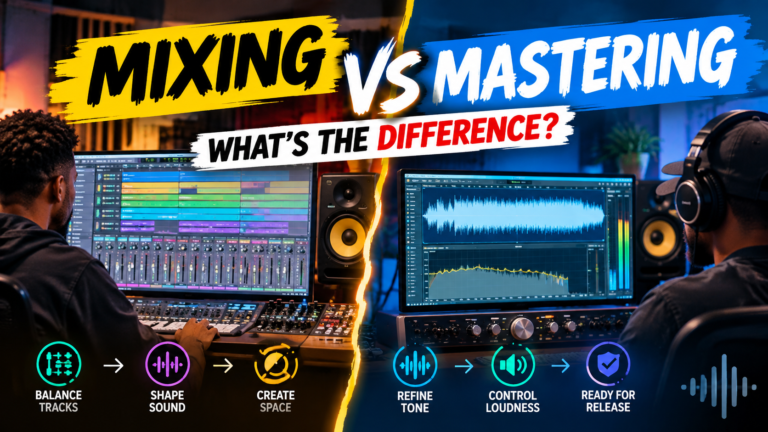
What About Mixing and Mastering?
This is where many beginners misunderstand what “recording a song” means.
You may record four songs in one day.
That does not necessarily mean you have four finished songs.
After recording, the project may still require:
Recording → Editing → Vocal Comping → Mixing → Mastering → Quality Control → Final Export
Mixing and mastering can take significant additional time depending on the complexity of the production and the standard required.
CFATMUSIC Studios‘ Professional Mixing and Mastering Service in Aba is designed for this later stage, where recorded vocals and instruments are balanced, processed and prepared as finished masters.
This distinction matters when planning a release.
If your goal is simply to capture vocals, your daily capacity may be high.
If your goal is to leave the studio with multiple completely finished commercial releases, your capacity will be considerably lower.
A Sample 8-Hour Recording Day
Here is one practical example for an artist who has three prepared songs.
9:00–9:30 AM — Setup and vocal warm-up
Microphone, headphone mix, session files and recording levels are checked.
9:30–11:30 AM — Song 1
Lead vocals, doubles, harmonies and selected ad-libs.
11:30 AM–12:00 PM — Break
Rest and review.
12:00–2:00 PM — Song 2
Lead vocals and additional layers.
2:00–2:30 PM — Lunch/break
2:30–4:30 PM — Song 3
Lead vocals, harmonies and ad-libs.
4:30–5:00 PM — Final review
Check recordings, organize takes and identify anything that needs attention.
5:00 PM — Session ends
This schedule does not guarantee three completed songs. But it gives the artist and engineer a realistic structure instead of trying to squeeze unlimited recording into eight hours.
The exact schedule should change according to the artist, genre, session goals and condition of the voice.
The Biggest Mistakes That Reduce the Number of Songs You Can Record
If your goal is to maximize studio time, avoid these common mistakes.
Arriving without lyrics
Trying to write every line while the clock is running can consume a surprising amount of studio time.
Changing the beat repeatedly
If the instrumental is not settled, the recording session can turn into a production session.
Recording without an arrangement
Deciding where every harmony and ad-lib goes while recording can significantly increase session length.
Taking too many unnecessary takes
More takes don’t automatically mean a better performance.
Spending too long listening after every take
You need to evaluate performances, but constantly stopping the session can destroy momentum.
Ignoring vocal fatigue
When the voice becomes tired, performance quality can decline and retakes can increase.
Trying to finish everything in one day
Some songs simply need more time.
There is nothing unprofessional about deciding that a song deserves another session.
So, How Many Songs Should You Actually Book a Session For?
If you’re unsure, use this simple rule:
For an 8-hour session, plan for 2–3 properly recorded songs and treat anything beyond that as a bonus.
If your songs are extremely simple and you’re well prepared, you may complete more.
If your songs require extensive vocal production, harmonies, live instruments or creative development, plan for fewer.
This approach gives you room to create rather than forcing you to race against the clock.
And if you’re paying by the hour, remember that preparation outside the studio is one of the best ways to reduce unnecessary studio costs.
Key Takeaways
- 2–4 songs in one day is a practical target for many prepared artists.
- Simple songs or demos may allow 4–6 songs.
- Layered Afrobeats, Gospel and complex productions may realistically require 1–3 songs per day.
- Preparation is one of the biggest factors affecting recording speed.
- Recording is not the same as finishing a song.
- Mixing, mastering, revisions and release preparation can happen after the recording session.
- Vocal health matters, particularly during long sessions.
- Quality should take priority over hitting an arbitrary number of songs.
Final Thoughts
So, how many songs can you record in one day?
If you are prepared, working with finished instrumentals and recording relatively straightforward vocals, you could potentially record several songs in a single day.
But if you are aiming for professional-quality releases with strong performances, layered vocals and careful production, two or three songs can be an excellent full-day target.
The smartest artists don’t measure a successful studio session by how many times they pressed the Record button.
They measure it by the quality of the music they created.
Before booking your next session, finish your lyrics, rehearse your songs, organize your beats, understand your arrangements and communicate your goals clearly with your producer or engineer.
Then walk into the studio ready to create.
If you are in Aba and need a professional environment for your next recording project, you can explore Cfatmusic Studios for recording, music production and related artist services. Artists building a larger catalogue can also explore Artist Development in Aba for broader career planning and development support.
Your goal isn’t to record the most songs in one day.
Your goal is to make the most of every song you record.