
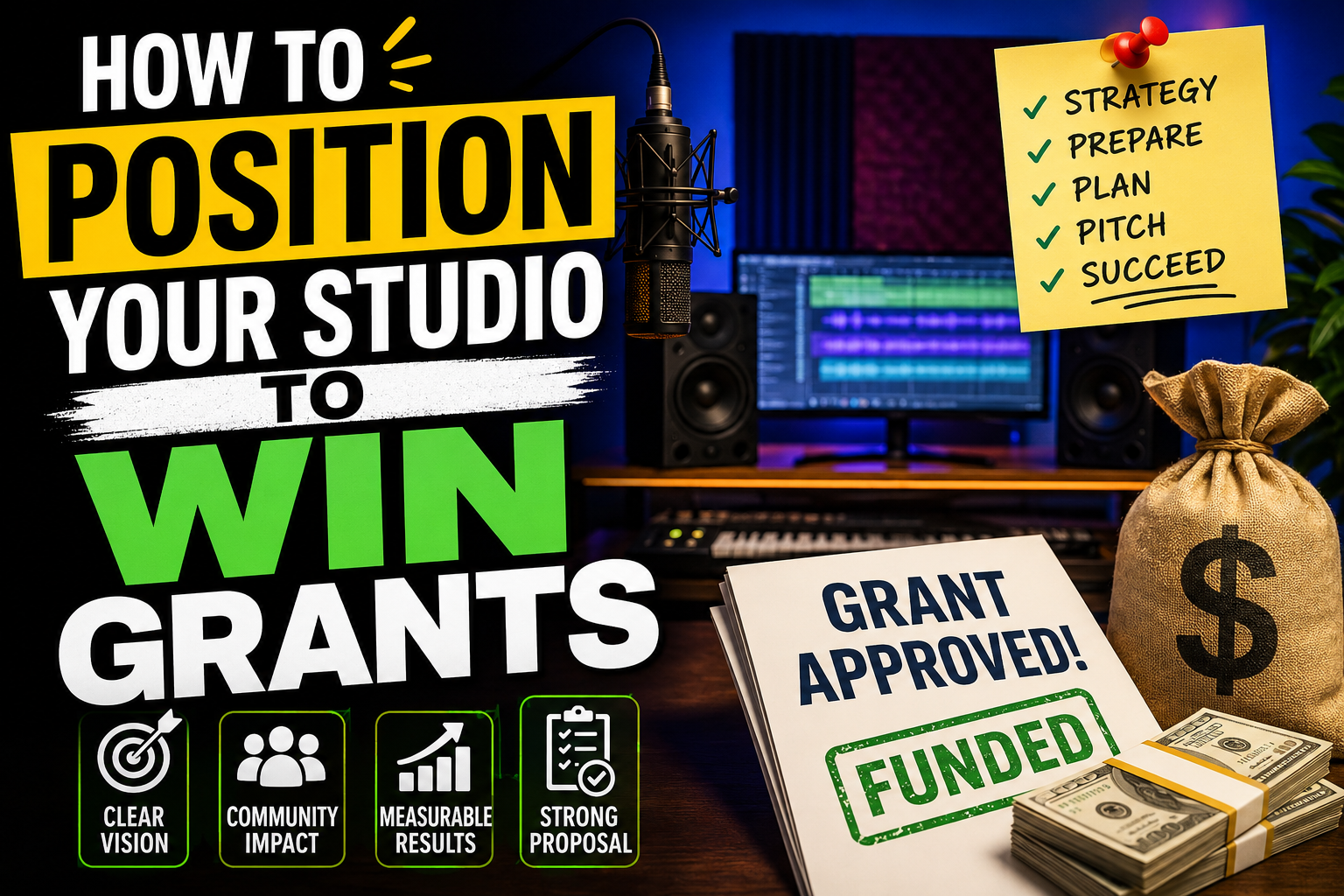

Table of Contents
Grant money is not just flowing toward the best-sounding rooms anymore. It is flowing toward the studios that can prove they matter: to artists, to young people, to a local economy, and to a wider creative ecosystem. That shift is now visible in how major arts funders write their rules. According to UNESCO, 2023, cultural and creative industries generate about US$2.25 trillion in annual revenue and nearly 30 million jobs worldwide, while employing more people aged 15 to 29 than any other sector. (1)
That is one reason grant panels have become more exacting. They are no longer impressed by ambition alone. They want evidence, structure, and a clear public benefit. According to the National Endowment for the Arts, 2026, its Grants for Arts Projects program expects about 4,000 applications, plans roughly 2,000 awards, and funds projects between $10,000 and $100,000, with a 1:1 cost share required. (2)
For studio owners, that means the real question is no longer, “Can we get a grant?” It is, “Can we position the studio so that a funder sees a believable, useful, measurable public purpose?” That question matters even more because creative workers are still under pressure. According to Arts Council England’s 2024 Creative and Cultural Freelancers study, 69% of current freelancers work mainly or only as freelancers, 73% reported pre-tax earnings under £25,000, and 81% said they hear about work through personal recommendations. (3)
The funding shift studios need to notice
The old idea that grants are only for charities, galleries, or education programs is now outdated. A modern studio can absolutely be grant-ready, but only when it is positioned as more than a room with microphones and speakers. Funders want to see a studio as a place where talent develops, careers start, communities are reached, and economic value is created.
More importantly, the strongest funding programs now reward projects with specific, definable activities rather than vague dreams. The NEA says projects should have clear activities, clear goals, and a realistic way to know whether those goals were met. It also says local projects can still qualify if they show significant community impact or best-practice value for the field. (4)
At the same time, the arts world is giving more attention to participation, equity, and access. According to NEFA’s 2023 announcement of ArtsHERE, the initiative was designed to strengthen organizations’ capacity to sustain meaningful community engagement and increase arts participation for underserved groups. NEFA later said the selected organizations demonstrated a strong commitment to equity in their practices and programming. (5)
Just as important, the direction of travel in music funding shows that studios are being judged by the doors they open, not only by the tracks they record. In Arts Council England’s 2025 Supporting Grassroots Music guidance, grassroots rehearsal and recording studios are defined as spaces whose main function is to provide rehearsal or recording space to emerging and independent artists and who play an important role in the local grassroots scene. The same guidance says the fund supports the sustainability and resilience of the grassroots music sector, and it is designed around pathways into music careers.
That matters because studios that only market themselves as commercial service providers may struggle to fit grant language. By contrast, a studio that shows how it helps young artists build real careers, serves an underrepresented scene, or strengthens a local creative corridor already sounds like a public-benefit project. In other words, the funding world is telling studios to describe themselves less like vendors and more like institutions with a mission.
What grant panels actually read for
Grant panels do not read applications like fans. They read them like risk managers. They want to know whether the project is clear, whether the team can deliver it, whether the budget makes sense, whether the people involved are credible, and whether the outcome is worth public or philanthropic money.
According to the NEA’s 2026 guidelines, artistic excellence includes the quality of the artists and partners involved, while artistic merit includes the project’s value to the mission and community, the ability to carry it out, the clarity of the budget, the qualifications of the team, the size of its impact, and the presence of clearly defined goals and an evaluation plan. (6)
Meanwhile, work samples matter more than many applicants realize. The NEA says work samples should be recent, concise, high quality, and directly related to the project. It warns that too many samples can be counterproductive because panel review time is limited. That is a useful lesson for studios: the strongest application is usually the one that proves its point quickly and cleanly. (7)
Just as revealing, the NEA says applications can be rejected if they do not sufficiently describe the project activities. That means a studio application should not read like a mood board. It should read like an operational plan: what will happen, who will do it, when it will happen, how it will be delivered, and what changes should follow. (8)
For that reason, studios that win grants usually do three things better than everyone else. First, they define the problem clearly. Second, they explain why their studio is the right place to solve it. Third, they show proof that the solution can work. That proof can include past projects, artist testimonials, attendance numbers, training outcomes, partnerships, or even simple before-and-after evidence such as more artists served, more sessions delivered, or more paid work created. The form matters less than the credibility. (9)
There is also a practical lesson in compliance. According to NEFA’s 2024 grant-writing advice, applicants should understand post-award obligations before they apply, including final reports and crediting requirements. That sounds minor, but funders often see follow-through as part of trust. A studio that handles reporting well looks safer to support again. (10)
That is especially true now because many creative professionals are working under pressure. The Arts Council England freelancer study shows a sector where support is often informal, earnings are thin, and opportunities still come through personal recommendations. In that kind of market, a grant-backed studio can become a stabilizing force if it offers paid opportunities, mentoring, and reliable access to equipment or space. (11)
What real funded music projects show
The clearest way to understand what funders reward is to look at real projects they have already backed. One example comes from Nottingham’s Broad Street Studio. In Arts Council England’s 2025 Supporting Grassroots Music guidance, the studio was supported to refit its space in the city’s creative quarter. The project focused on improving access for artists of black origin, gave 40 artists working in R&B, Hip Hop, Bashment, Dancehall, Reggae, and Amapiano free access to the refurbished studio, and supported their career pathways through a 23-event showcase at a local venue.
That example is useful because it shows how a studio becomes fundable when the project is not just “upgrade the room,” but “open the room to a defined group, help them produce visible work, and connect that work to the next stage of their careers.” The grant did not simply buy equipment. It created access, output, and progression.
Another strong example is South Block in Glasgow, which appears in Arts Council England’s Cultural Cities Enquiry case studies. The project was built around three goals: bringing life to an empty listed building, providing more affordable artist studio space, and creating a self-sustaining social enterprise without revenue funding. The case study explains that South Block offered rent-only studios, flexible workspace, business support, meeting spaces, and a café whose income helped subsidize the creative spaces.
That story matters because it shows how infrastructure can be positioned as public value. The funders were not only buying floor space. They were supporting regeneration, affordability, collaboration, and a business model that could stand on its own feet. In grant terms, that is a powerful blend of culture and sustainability.
A third real example comes from the St Mary’s Arts Trust in Ashford. Arts Council England’s Supporting Grassroots Music guidance says the trust led a consortium project to create a “music village” across a month-long series of events with four other venues. The project used a range of venue sizes to attract different acts and genres, while a strong professional-development focus gave the work legacy beyond the event run.
Then there is the wider sector evidence. According to Arts Council England’s Supporting Grassroots Live Music evaluation, the fund invested more than £6 million in 250-plus projects by July 2022, and later more than £7.23 million through 378 awards. The evaluation also found that the fund helped venues and promoters test new business models, diversify programming, strengthen partnerships, and improve their confidence and quality in applying for future support.
One sector voice in that evaluation described the program as “a really vital intervention,” a line that captures something funders often want to hear but seldom say directly: they are looking for projects that solve a real gap, not simply apply for money because money exists. The same evaluation describes the program as a “training ground” that helped grassroots groups become better prepared for mainstream applications later.
Taken together, these examples show a pattern. The winning studio is rarely the one asking for support in the broadest terms. It is the one that turns itself into a platform for a defined community, a credible outcome, and a future story the founder can believe in.
The positioning moves that make a studio grant-ready
The first move is to define your studio as a mission-led space. That does not mean pretending to be something you are not. It means naming the public value already present in your work. If you train artists, say so. If you give new talent access to recording time, say so. If your studio helps women, young people, independent artists, or a specific local scene build careers, say so clearly and show evidence. Funders respond to clarity because clarity reduces doubt. (12)
The second move is to package your work as a project, not a wish. The NEA says projects should be specific and definable, and the application can be rejected if it does not sufficiently describe the activities. So a studio should present a tight project frame such as artist development, youth access, production training, sound engineering mentorship, archive work, or community-based sessions. A strong project tells the funder exactly what the money will do. (13)
The third move is to show proof of delivery. That proof can be small, but it must be real. A studio that has already hosted sessions, built audience trust, or worked with partner groups is easier to back than one trying to leap from zero to large-scale claims. According to the NEA’s eligibility rules, applicants in the U.S. also need a real organizational track record, minimum operating expenses, and at least five years of arts programming for some programs. Even where those exact rules do not apply, the principle still matters: funders like history because history lowers risk. (14)
The fourth move is to build partnerships that make the proposal look bigger than the building. In the NEA framework, the qualifications of the project’s personnel and partnerships are part of artistic merit. In UK arts guidance, projects that show value for audiences, communities, and the local scene are favored. This is why schools, community groups, talent networks, universities, local councils, and cultural organizations can make a studio application stronger. Partnerships signal reach and resilience. (15)
The fifth move is to prove that money will translate into outcomes. Funders want to know how success will be measured. That does not have to be complicated. It can be the number of artists served, the number of sessions delivered, the percentage of participants from underrepresented groups, the number of paid opportunities created, or the number of final works produced. The Arts Council England study of freelancers shows why this matters: many creative workers face low pay and weak formal support, so a studio that can document paid access, progression, and mentorship is addressing a real sector need. (16)
The sixth move is to understand what the fund does not want. Arts Council England’s Supporting Grassroots Music guidance says the fund is not primarily for community music making, entry-level workshops, or broader social and educational outcomes unless they connect directly to the sustainability of the grassroots music pipeline. That is a crucial lesson. A studio does not win grants by promising everything. It wins by matching the right fund with the right story.
Finally, the best positioning work happens before the application opens. The studios that do best are usually the ones that have already gathered images, attendance numbers, artist feedback, partner letters, budgets, and short case notes on what changed because they existed. As NEFA advises, grant writing takes time, and applicants should think carefully about whether the work is worth the effort, including what reports will be needed afterward. In grant terms, preparation is not extra work; it is the work. (17)
A studio that wants to win grants should therefore stop thinking only about gear and acoustics and start thinking about evidence, access, and outcomes. The room still matters, of course. But in today’s funding climate, the story around the room matters just as much. The studios most likely to win are the ones that can show a funder this simple chain: a real need, a clear plan, a capable team, a defined community, and a result worth paying for. That is what turns an ordinary studio into a grantable idea. (18)







[…] Likewise, Arts Council-supported projects have increasingly rewarded studios that expand access for underserved artists, deliver training programmes, and contribute to local creative ecosystems instead of merely improving physical spaces. (cfatmusicstudios.com) […]
very true… thank you for engaging with my post. I appreciate.
[…] grants for recording, touring, video production, social media campaigns, and more. When applying, make a clear proposal: explain your project scope, how funds will be used, and the impact on your career. Keep in mind […]