
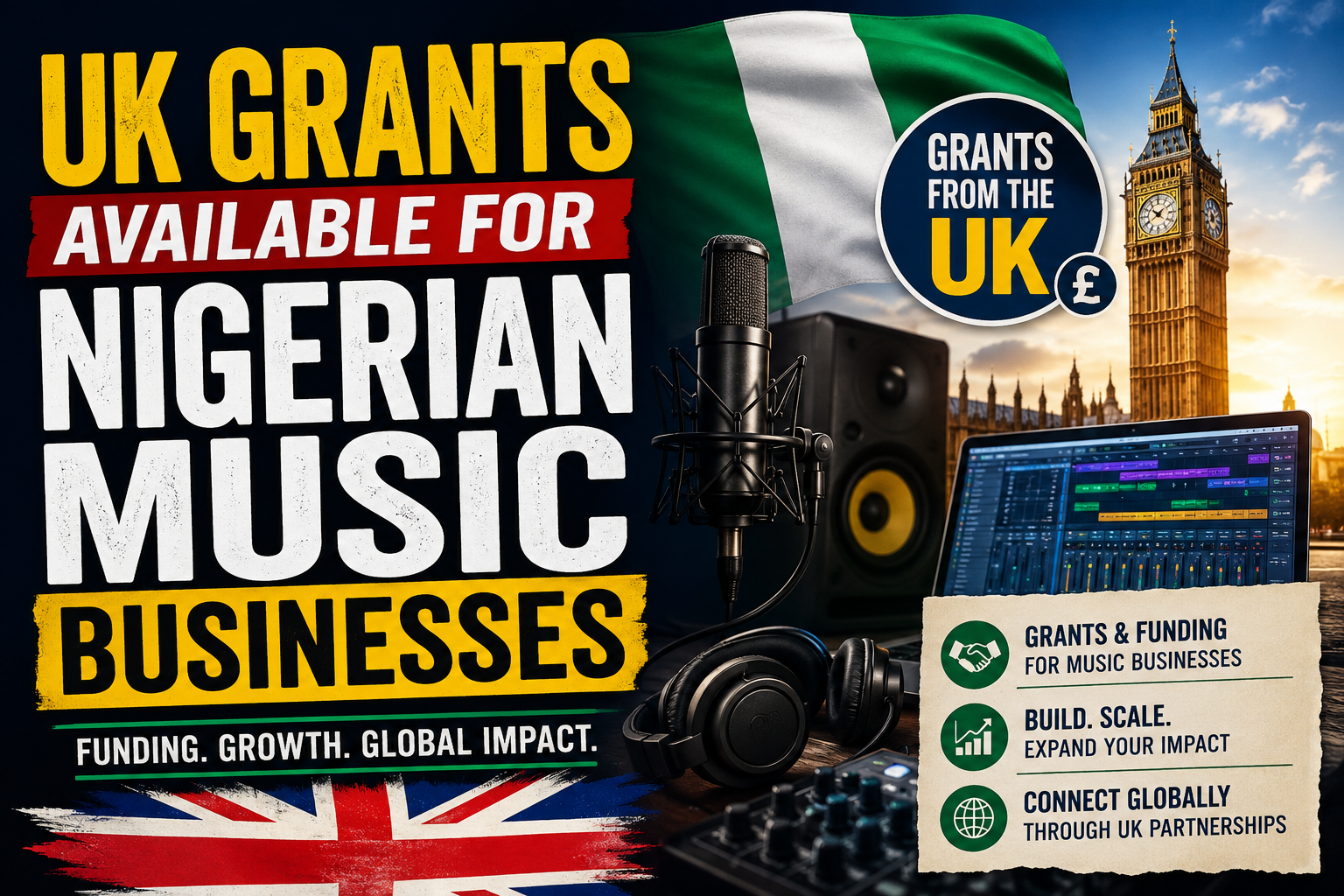

Nigeria’s music sector is in a strange and powerful moment. On one hand, the country’s sound is global. Afrobeats has become a worldwide business, Nigerian producers are shaping chart records, and London, Lagos, and other creative capitals now talk to each other more often than before. On the other hand, many of the businesses behind the music still struggle with the basics: equipment, training, export marketing, touring costs, and production budgets. That gap matters because music is no longer only an art form; it is a small business, a tech business, and an export business at the same time. The funding question is therefore not a side issue. It is the difference between growth and stagnation. Recent UK and UK-linked programmes now give Nigerian music businesses more routes than they had in the past, but most of those routes reward collaboration, planning, and measurable outcomes rather than talent alone. (1)
The clearest sign of the opportunity gap came from The Creative Fund, a 2026 initiative funded by the UK Foreign, Commonwealth & Development Office and administered through the UK-Nigeria Tech Hub. According to the programme, it offers project-first grants for film, fashion, and music in Nigeria, and it was built in response to a 2024 study based on more than 1,700 survey responses, 90-plus interviews, and fieldwork across seven states. That study found that Nigeria’s creative economy employs 4.2 million people and contributes about US$3 billion to GDP annually, but fewer than 10% of practitioners access formal financing and more than 80% are self-taught. In plain English, the talent is there, but the money pipeline is still too narrow. (2)
That is why the current UK funding landscape matters to a Nigerian studio owner, producer, label founder, sound engineer, or music entrepreneur. The British Council’s arts work in Sub-Saharan Africa now explicitly includes Nigeria, and it says its focus covers music, creative technology, and other art forms, along with grant funding, training, research, policy work, and market access support. At the same time, the UK’s cultural and trade institutions are openly talking about deeper Lagos-London creative links. In 2025 and 2026, London’s mayoral and British Council messaging repeatedly framed Lagos as a major creative hub and a serious partner for music and film exchange. That is not just diplomatic language; it is a signal that cross-border creative business is being taken more seriously. (3)
The UK-Backed Routes Nigerian Music Businesses Can Actually Use in 2026
The most directly relevant opportunity right now is Connections Through Culture 2026, the British Council’s current international collaboration grant programme. According to the official toolkit, the scheme offers grants of between £5,000 and £15,000, Nigeria is listed among the participating countries, and projects must involve at least one UK-based partner and one partner based in an eligible country. The programme covers music, along with film, literature, theatre and dance, visual arts, creative technology, and more. It is also open to artists, organisations, hubs, networks, collectives, festivals, and cultural professionals. The deadline is 12 August 2026, and applications must be submitted in English through the Good Grants platform. For Nigerian music businesses, that means the route is real, but it is collaborative rather than solitary.
That structure is important because it tells applicants what kind of thinking funders want. The British Council says the programme is designed to support meaningful relationships, cross-cultural exchange, co-creation, long-term collaboration, shared learning, and mutual benefit. In other words, a proposal that only asks for money to “do a project” is weaker than one that explains how a Nigerian music business and a UK partner will create something together, reach audiences in both places, and leave behind a lasting business or artistic relationship. For a studio owner, that might mean a joint songwriting camp, a producer exchange, a live recording collaboration, a cross-border showcase, or a training programme that improves technical capacity on both sides. The strongest applications are usually the ones that show the partnership before the money arrives.
Then there is The Creative Fund, which is even more relevant if the business is operating inside Nigeria rather than through a UK partner. The fund describes itself as project-first and flexible, aimed at high-potential creative projects in film, fashion, and music, and says it exists to subsidise the technical talent, digital tools, and resources that keep Nigeria’s best creative work at home. That language matters because music businesses rarely only need “artist support”; they often need production infrastructure, post-production skills, technical staff, and digital delivery systems. If a studio is trying to upgrade recording quality, a label is trying to scale a release pipeline, or a music brand is building a content production workflow, that is the kind of business problem the fund appears designed to address. (4)
It is also worth understanding what is not directly available to Nigerian applicants. The Music Export Growth Scheme, better known as MEGS, is a UK scheme. According to BPI, it is developed and administered to support small-to-medium-sized independent UK companies as they build the commercial profile of their artists in overseas markets. BPI’s latest 2025 and 2026 announcements show that the scheme is aimed at British music exports and UK companies, not Nigeria-based businesses applying on their own. Even so, it still matters to Nigerian entrepreneurs because it shows how funders think: export growth, international audience building, and promotional spend are all seen as worthy of support. In other words, MEGS is not a direct route for most Nigerian companies, but it is a useful template for how to design an international music-growth proposal. (5)
The broader British Council record also gives Nigerian music businesses a sense of continuity rather than a one-off opportunity. The organisation says its Sub-Saharan Africa arts programme supports artistic innovation, cultural exchange, sustainable creative sectors, and collaboration with local partners across 11 countries, including Nigeria. It also says it helps creatives access new markets and build skills through training, grant funding, research, and policy engagement. That is a useful clue for any applicant trying to understand where money and support are coming from: the British Council tends to back ecosystem-building, not just one-off shows. Businesses that fit into training, partnership-building, or market development usually have a stronger case than those that only ask for a short-term cash injection. (6)
What Strong Applications Look Like to Funders
A recurring mistake among applicants is to describe their dream instead of their delivery plan. The better approach is to show a project that can be measured. The current British Council toolkit makes this very clear when it says applications should explain how partners will work together, what each partner will contribute, and how the project will create mutual benefit. It also says the grant must cover the full partnership activity, including costs on both the UK side and the participating-country side. That means budgets need to be balanced, realistic, and written in sterling. It also means the project should not look like a vague networking exercise. Funders want activity, process, output, and evidence.
That is where many Nigerian music businesses can improve quickly. A strong proposal is usually built around a concrete pain point: low-quality live production, weak export visibility, poor metadata, limited technical skill, poor recording infrastructure, or thin audience reach. In a British Council Nigeria interview, UK producer Sam Jones said the most useful support is “market relevant training,” and he also said “better access to kit is extremely important.” Those remarks capture the reality of the sector very well. Talent matters, but if the studio cannot maintain gear, if the sound engineer lacks practical training, or if the marketing pipeline is weak, then the business does not scale. A funder is much more likely to back a project that fixes a real bottleneck than one that simply celebrates music culture. (7)
The data backs that up. According to the British Council’s 2025 evaluation of its Sub-Saharan Africa arts programme, 73% of respondents said they gained new skills or knowledge that would help them economically later. The same report found that 86% increased social media visibility, over half secured new connections, almost half won new business, and a third accessed additional grant funding. That is an important lesson for Nigerian music businesses: good programmes should not only produce art, they should also produce professional gains such as better visibility, new clients, stronger partnerships, and more fundable future work. If your application can show those outcomes, it starts to look less like a wish and more like an investment.
There is also a credibility effect that funders notice. The same British Council evaluation includes participant testimony saying that association with the British Council improved attention and credibility, while another participant described the programme as helping them establish a creative enterprise and build a solid catalogue and fan base. Those are not just nice-sounding lines. They show what many grantmakers are really buying: proof that a small intervention can create a longer business trajectory. For a Nigerian music company, that could mean a grant to produce a collaborative EP, record a live session series, train two engineers, and package the content for international distribution. The strongest proposals usually combine art, business, and audience growth in one plan.
Real Projects Show the Path Forward
Real examples from the UK-Nigeria grant ecosystem show what this looks like in practice. In the British Council’s UK/Nigeria 2015–16 report, 13 projects received grants of between £5,000 and £10,000 for UK or Nigerian artists and arts organisations. Among them was Big 60: Lagos and London, a lifestyle and cultural installation that blended food, film, art, illustration, and music across both cities to promote cultural exchange. Another project, GidiJand, used pop-up recording and video shoots of musical performances across public spaces in Lagos to celebrate the diversity and richness of music and place. These are useful case studies because they prove that music projects win when they are connected to exchange, public visibility, and a wider creative economy story. (8)
The same report also shows that youth music collaborations can cross borders successfully. One project, On Mass, brought together young musicians from Ukraine, Nigeria, and South Africa and culminated in a performance at London’s Roundhouse. That matters for Nigerian music businesses because it shows funders are often interested in mobility, artistic exchange, and joint audiences, not just local production. In practical terms, a Nigerian label, studio, or music collective can design a project around visiting artists, producer exchange, live performance, and documented output that can travel digitally after the event is over. The point is not to copy the old project, but to learn the funding logic behind it. (9)
There is also a strong lesson in how the UK and Nigeria now talk about creative collaboration at the institutional level. In March 2026, the British Council said the UK and Nigeria were forging new pathways in creative collaboration, while London’s 2025 Africa trade mission highlighted stronger ties between London and Lagos from arts to music and film. The same City Hall report noted that Lagos was ranked top city for creative economy performance in Africa’s Creative Vibrancy Index. That is a meaningful signal for music businesses on the ground. It suggests that a Nigerian music company with a credible UK partner is no longer pushing against an invisible wall; it is stepping into a corridor that is already being opened by institutions, trade missions, and cultural agencies. (10)
A final and practical lesson comes from the British Council’s own assessment of how its arts programmes work across the region. The evaluation says partnerships built through the programme have lasting economic value, while high-level strategic collaborations in Nigeria have already been formalised. It also says strategic partnerships across governments, trusts, foundations, and public and private bodies have grown stronger over time. This is the real playbook for Nigerian music businesses: do not think only in terms of “one grant.” Think in terms of relationship capital, future co-productions, joint applications, and a track record that gets stronger with each successful project. A grant can open a door, but a partnership can keep it open.
The most practical advice, then, is simple. Start with the right route, not the biggest fantasy. If the idea depends on UK-Nigeria collaboration, build the UK partner first and make the shared outcome obvious. If the idea is Nigeria-based, study the Creative Fund and shape the project around a real business problem in music rather than around vague artistic ambition. Keep the budget realistic, the language plain, the outcome measurable, and the delivery timeline believable. Above all, show how the grant will improve skills, infrastructure, visibility, or revenue, because that is where funders already see value. In 2026, Nigerian music businesses do have access to UK-linked funding pathways, but the winners will be the ones who treat those pathways like business opportunities, not charity.







[…] UK Grants Available for Nigerian Music Businesses: — How to Apply Smarter in 2026 […]
[…] UK Grants Available for Nigerian Music Businesses: — How to Apply Smarter in 2026 […]
[…] UK Grants Available for Nigerian Music Businesses: — How to Apply Smarter in 2026 […]
[…] UK Grants Available for Nigerian Music Businesses: — How to Apply Smarter in 2026 […]