
Before you write a single word, understand this: grant writing is not just about asking for money. It is about proving that your project is worth backing, that your team can deliver it, and that the outcome will matter to the funder just as much as it matters to you. That logic is more important today than ever, because the creative economy is no longer treated as a side story. UNESCO says cultural and creative industries account for 3.1% of global GDP and 6.2% of global employment, while UNCTAD’s 2024 creative economy outlook notes that Nigeria’s creative industries employed roughly 3.2 million people — about 6% of total employment. Here in Nigeria, the government has also opened bigger funding channels, including the Creative Economy Development Fund and the iDICE programme, both designed to help creative and digital ventures scale. In other words, the money exists. But so does the competition — and it is serious. (1)
Here is the most important shift in mindset you need to make: the first step in winning a grant is not writing. It is reading. Grants.gov advises applicants to first check eligibility, identify opportunities that align with their work, and register properly before applying. NIH guidance shows that proposals perform better when goals are realistic, structure is organised, and language is clear. NSF goes further, saying your project description must explain what you want to do, why you want to do it, how you will do it, how you will know if it worked, and what benefits will follow. That means a strong proposal starts with fit, not flair. If the funder asks for a specific purpose, your application must answer that purpose directly. (2)
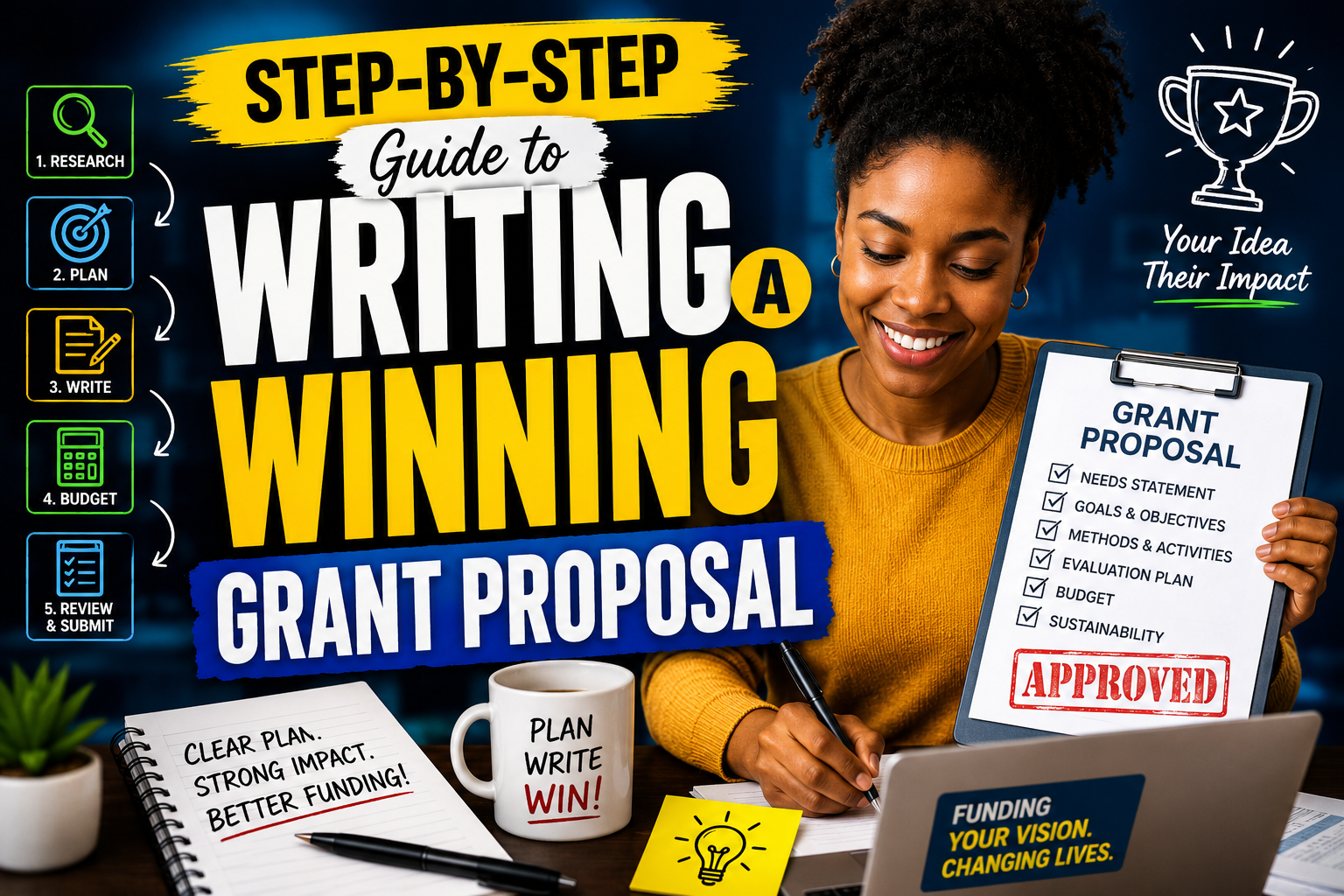
The six parts funders expect to see
- 1. Write your need statement like you are explaining it to a smart stranger.
Write your need statement as if you are speaking to an intelligent reader who knows absolutely nothing about your project. Candid says the need statement should persuade the funder that the problem is urgent, and it should do so through a combination of data and human story. NIH also reminds applicants that reviewers are your primary audience, which means your case must be simple enough to follow quickly and compelling enough to matter. A strong need statement does not rely on emotion alone. It shows what is broken, who is affected, why it matters right now, and why your project is the right response. In practice, that is the difference between saying “we need support” and proving why support should come from this specific funder for this specific project. (3)
- 2. Separate your goals from your objectives — they are not the same thing.
Candid explains that goals are broad directional statements, while objectives must be specific, measurable, attainable, relevant, and time-bound. NIH echoes this in simpler terms by urging applicants to keep goals realistic and clear. This distinction matters because many proposals fail not because the idea is weak, but because the project is too vague. Your funder wants to know what success will actually look like. So do not just say you want to “empower young creatives.” Say how many people you will reach, what will change for them, and how you will track that change. A funder can admire ambition, but it can only approve specificity. (4)
- 3. Turn your idea into a clear, scannable work plan.
Once you know what you want to achieve, show exactly how you will get there. NSF’s proposal guide says your description should cover what you plan to do, how you will do it, how you will measure success, and what value the result will create. NIH adds that applications should be organised so reviewers can find information quickly — using headings, short paragraphs, and a clean structure. This is especially important for creatives who are used to pitching from instinct. A grant proposal is not a live pitch. It is a written case. Your reviewer must be able to scan your plan and understand the timeline, the deliverables, the team, and the method without guessing. If your process looks scattered on paper, the funder will assume the project will be scattered in practice. (5)
- 4. Treat the budget as part of your argument, not just paperwork.
Many applicants rush the budget. Funders read it carefully — sometimes first. Candid says funders often review the budget before anything else, because it reveals credibility and shows whether numbers reflect real impact. A budget that does not add up is an immediate red flag. NSF says the budget must show the amount requested across each year of support, while NIH says every line item must be reasonable and justified by the actual work being proposed. So build your budget to reflect the true cost of delivery — staffing, supplies, outreach, production, travel, evaluation, and those behind-the-scenes costs that keep everything running. If your numbers look careless, your entire application will start to look careless too. (6)
- 5. Prove that your team can actually do the work.
A great idea without the right people behind it is just a pitch. NSF asks for biosketches and current-and-pending support documents for key personnel so reviewers can judge whether the team has the right experience and bandwidth. That lesson goes far beyond science. In the creative world, a funder wants to know whether you have delivered work before, whether your team is stable, and whether the people involved have what it takes to see the project through. A proposal without evidence of capacity can still sound exciting — but excitement is not enough. Funders want assurance that the work can survive the pressure of execution, reporting, and accountability. (7)
- 6. Revise until your proposal is easy to read — for compliance, not just clarity.
Once the content is solid, go back and clean up the language. NIH says applications improve when the writing is clear, concise, and direct. Candid reminds applicants to always follow the funder’s guidelines and keep language simple. Grants.gov points applicants to the learning centre and the application process as reminders that grant writing is about compliance just as much as it is about content. This is where many strong ideas fall apart — not because the concept is weak, but because instructions were skipped, an attachment was formatted incorrectly, a requirement was overlooked, or the submission was left too close to deadline for a proper final review. In grant writing, polish is not decoration. It is part of the argument. (8)
What Nigerian creative funding cases show in practice
The Nigerian funding landscape is shifting — and what that shift reveals can sharpen how you write your next proposal.
When the federal government launched the Creative Economy Development Fund in 2025, it announced support for fashion, film, music, gaming, tourism, and content creation through grants, soft loans, equity funding, and capacity building. The Youth Initiative’s breakdown of the fund also noted that the programme uses IP-backed financing, meaning applicants can use intellectual property rather than physical collateral. That is a critical insight for grant writers. It tells you that the strongest applications will not be built on ownership of land or equipment alone — they will be built around proof of creative value, market potential, and the ability to turn intellectual property into real growth. (9)
Real beneficiaries make this even clearer. In 2024, Jazzhole received a Nigerian grant to digitally remaster rare archival recordings and preserve Nigeria’s sonic heritage. The company described the project as a legacy effort — not just a short-term assignment. That is exactly what a funder wants to feel when reading your proposal: that this project has public value, a clear outcome, and a reason for existing beyond the immediate funding. Jazzhole’s case proves that cultural preservation becomes fundable when it is framed as a concrete project with a defined result and a visible benefit to the wider public. (10)
But the other side of this picture matters just as much. Fashion entrepreneur and dance brand founder Kaffy has been open about the fact that her work was largely self-funded, and that banks initially dismissed dance as a serious business. She also pointed to structural gaps in the industry, arguing that the creative sector often lacks the support systems that help other industries scale. That experience is important, because it explains why many Nigerian creatives write weak grant proposals. They have spent so long proving that their work is real that they forget the application must prove something different: that the project is organised, measurable, and ready for external support. Passion may open the story, but structure wins the fund. (11)
The fashion industry has made the funding gap impossible to ignore. A Nigerian fashion voice told Premium Times in 2025 that the sector needed genuine support to move from survival to global dominance, and raised concerns about whether funding announcements were actually reaching the right people. That concern carries a useful lesson for grant writers. Many proposals speak broadly about industry transformation, but they fail to show transparency, delivery milestones, or accountability. In a competitive process, the funder is not only looking for creativity. It is looking for evidence that the applicant understands governance, reporting, and real-world implementation. (12)
The wider financing environment confirms all of this. The World Bank has noted that traditional financing is often a poor fit for creative industries because these businesses typically lack tangible collateral, face uncertain demand, and take time to generate value. The Bank also points out that weak intellectual property protection makes it harder to demonstrate the economic value of intangible assets. That is exactly why creative applicants often lose when they write proposals like ordinary loan requests or casual artist statements. A winning grant proposal must help the funder see your project as an asset in progress — not a vague hope. It must show how the work will create value, how that value will be protected, and how the funding will move the project forward. (13)
And know this: the competition will only intensify. In 2024 and 2025, Nigeria’s digital and creative industries remained central to national funding discussions, including the iDICE programme targeting young women and men aged 15 to 35, early-stage ventures, and creative businesses. The federal government also announced disbursements from a N5 billion creative fund to support Nollywood. These moves signal something important: institutions are no longer debating whether the creative economy is real. They are deciding which projects deserve support first. That is precisely where proposal quality becomes decisive. The applicants who can clearly explain impact, use of funds, and long-term sustainability will stand out. (14)
The simplest way to raise your odds on the next submission
The most practical shift you can make is to think like both a creator and a reviewer at the same time. Start with the problem, prove the need, show the solution, lay out the plan, justify the money, and introduce the team. NIH’s guidance remains one of the clearest frameworks for this: make your goals realistic and clear, keep the writing organised, use concise language, and remember that reviewers are your primary audience. Candid adds that applicants should use feedback, follow guidelines, and make proposals genuinely easy to read. Together, these ideas form one simple rule: if a stranger can understand your proposal quickly, you are already ahead of most of your competition. (15)
Strong writing, though, is about more than style. It is about trust. A budget that matches your narrative, a timeline that holds up to scrutiny, a team with a track record of delivery, and a proposal that answers every question directly — these are the things that build a funder’s confidence in you. That is why Candid says funders spot red flags when applicants ignore instructions, when budgets do not add up, or when outcomes are confused with activities. It is also why NSF asks for a clear explanation of success, not just a list of planned actions. Funders are not rewarding the most dramatic language. They are rewarding the best logic. (16)
So before you submit, run three final checks. First, does your project solve a real problem that this specific funder cares about? Second, does your budget honestly reflect the actual cost of the work? Third, can a reviewer read your application and see a credible path from funding to outcome? If the answer to all three is yes, your proposal is ready. If the answer to any one of them is no, sit back down and keep working. In grant writing, the difference between rejection and approval is rarely the brilliance of the idea. It is the clarity with which that idea is presented, justified, and made easy to believe. (17)
And if your proposal is rejected — do not treat it as the end. Candid says a rejection letter can become an opportunity to build relationships, ask better questions, and strengthen the next submission. That is especially relevant for Nigerian creatives, because many of these funding paths are still new, and most applicants will need more than one attempt before they win. Keep your project file updated. Keep your budget clean. Keep your evidence of impact visible. And keep learning the language that funders actually use. Winning a grant is not about sounding desperate. It is about sounding ready. And readiness, more than anything else, is what funders are truly investing in. (18)