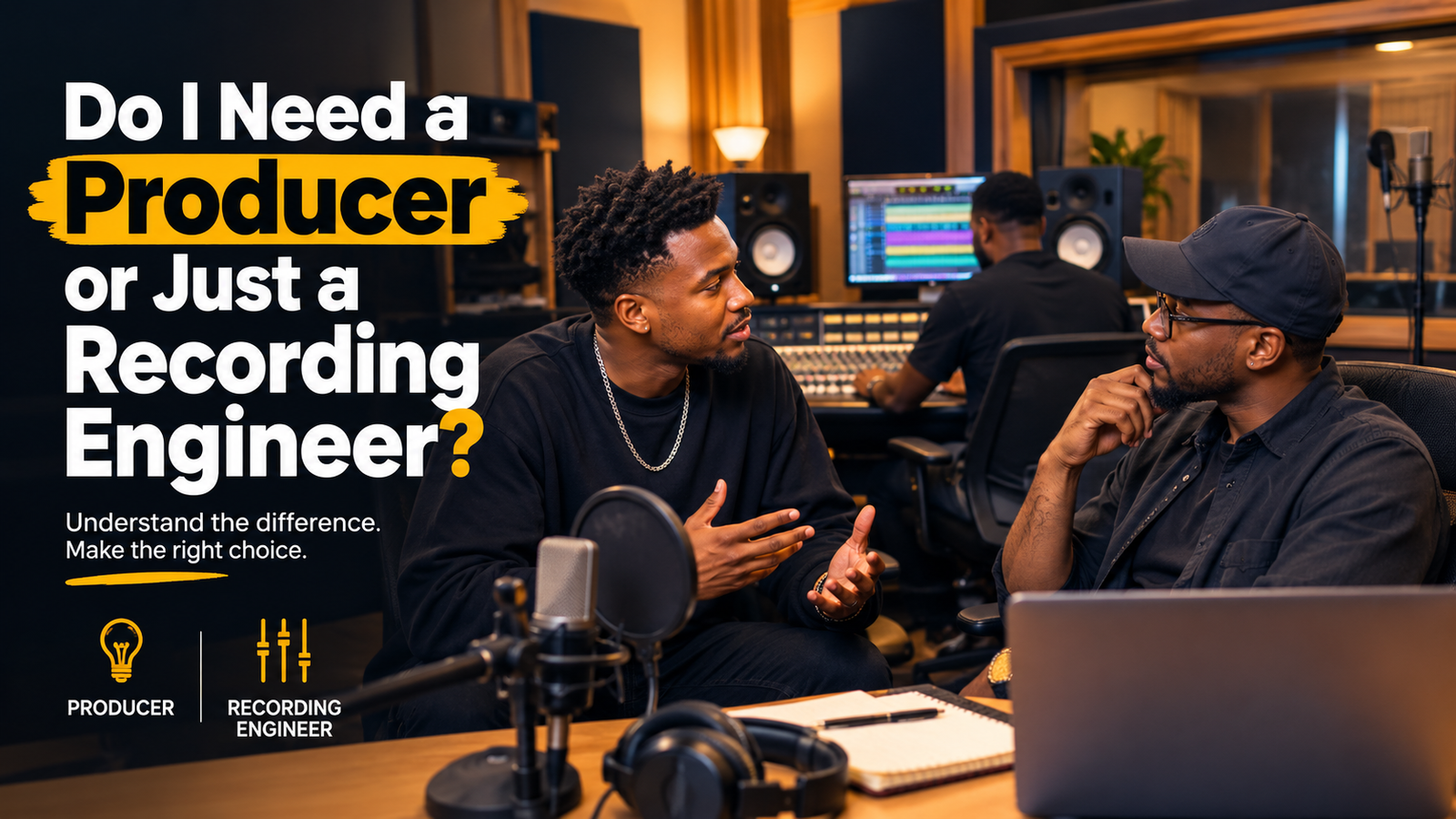

Producer or Just a Recording Engineer? Walking into a recording studio for the first time can be confusing. You may hear people talk about a music producer, recording engineer, mixing engineer, and sometimes even a vocal producer as though they all do the same thing.
They do not.
A recording engineer is primarily responsible for capturing the performance properly and managing the technical side of the recording session. A producer is much more involved in shaping the creative direction of the song — from the arrangement and instrumentation to the artist’s performance and overall sound. In some studios, one experienced professional may handle both roles, but the responsibilities themselves are different.
So, do you need a producer or just a recording engineer?
The answer depends on how prepared you are, what kind of project you are making, and whether you already know exactly what the song needs.
For some artists, a good recording engineer is enough. For others, working with a producer can make the difference between simply recording a song and actually developing a strong record.
Producer or Recording Engineer: What Is the Difference?
The easiest way to understand the difference is this:
A recording engineer focuses on capturing the music. A producer focuses on shaping the music.
There is overlap, especially in smaller studios where one person may wear several hats, but the core responsibilities are different.
A recording engineer sets up the microphones, manages the recording software and equipment, gets appropriate recording levels, monitors the session, organizes takes and tracks, and works to capture the artist and instruments accurately. Berklee describes the recording engineer as responsible for many of the technical and aesthetic aspects of a recording session and for ensuring that the recorded material gives the mixing stage a strong foundation.
A music producer, on the other hand, helps shape the actual record. Depending on the project, a producer may develop the song and arrangement, choose or suggest collaborators, guide the artist’s performance, make creative and technical decisions, and oversee the recording process through later stages of production.
Think of it this way:
The engineer asks:
“How do we capture this performance properly?”
The producer asks:
“Is this the right performance, arrangement, sound, energy and direction for this song?”
Those questions often happen in the same room.
What Does a Recording Engineer Actually Do?
A professional recording engineer is not simply the person who presses the record button.
Before recording starts, the engineer may prepare the studio, choose and position microphones, connect equipment, create the recording session, check signal flow and make sure the technical setup is working correctly. During the session, the engineer monitors the recording, manages takes and helps maintain a clean and usable recording environment.
For example, imagine you are recording an Afrobeat vocal.
You arrive at the studio with a finished instrumental and know exactly how you want to sing the song. You already understand the melody, lyrics, harmonies, vocal style and structure.
In this situation, you may not need someone to develop the record with you.
You need someone who can:
- choose an appropriate microphone and recording setup;
- get the vocal level and signal chain right;
- give you a reliable headphone mix;
- record multiple takes cleanly;
- help organize comp takes;
- make sure you do not clip or distort the recording;
- keep the session moving efficiently.
That is primarily an engineering job.
A great engineer can also give useful performance and sonic feedback, particularly when they understand music well. The boundary between technical and creative work can become quite fluid in real studio sessions.
What Does a Music Producer Do?
A producer works at a broader creative level.
The producer may listen to your demo and immediately identify problems that have nothing to do with microphones.
Perhaps the chorus does not feel strong enough.
Maybe the second verse is too long.
The melody might be fighting the instrumental.
Perhaps the song needs another instrument, a background vocal arrangement, a different drum pattern or a stronger transition into the chorus.
Maybe your vocal performance is technically acceptable but does not communicate the emotion of the lyrics.
These are production questions.
According to Berklee, music producers may be involved in songwriting and arrangement development, session planning, collaborator selection, performance direction, technical and aesthetic decisions, budgeting and scheduling, and oversight through mixing and mastering.
GRAMMY’s educational material similarly describes the producer as someone who oversees the creation of songs and helps guide artists through recording, arrangement and overall sound.
This is why simply hiring an expensive studio does not automatically mean you are getting production.
You can record a song in a beautiful room with excellent microphones and still end up with a weak record if the underlying creative decisions are weak.
Do You Need a Producer If You Already Have a Beat?
Not necessarily.
This is one of the most important distinctions for independent artists.
Suppose a producer has already created an instrumental that you love. You have written the song, chosen the melody, planned the vocal arrangement and know exactly how you want to perform it.
At that point, your main need may simply be professional recording.
You could book a session recording service and work with a recording engineer who can capture your performance properly.
However, having a beat does not automatically mean the song is fully produced.
A beat can still require creative decisions.
For example:
- Should the intro be shorter?
- Should the second verse use a different vocal approach?
- Should the chorus have doubles and harmonies?
- Does the bridge need to be added?
- Should certain instruments drop out before the hook?
- Would another vocal texture make the chorus more memorable?
- Is the song in the right key for your voice?
- Should the arrangement create a bigger final chorus?
A producer can help answer those questions.
When You Probably Need a Producer
You should seriously consider working with a producer when you are not completely sure how to turn your idea into a finished record.
This is especially useful when:
You have a song idea but not a finished arrangement
You may have a melody, lyrics and a voice note, but the song still needs structure and musical development.
A producer can help turn the rough idea into a recording plan.
You struggle with vocal performance
Some artists can sing the notes correctly but still fail to communicate the song convincingly.
A producer may stop a take, suggest a different emotional approach, change phrasing, request another layer, or ask the artist to simplify a section.
GRAMMY material on producer-engineer collaboration emphasizes that producing is a team activity centered on realizing the artist’s vision.
Your songs sound repetitive
If every song has the same intro, same arrangement, same vocal treatment and similar energy, you may need an outside creative perspective.
A producer can help you develop variation without destroying your identity.
You are recording an important single, EP or album
For larger projects, consistency becomes more important.
A producer can help maintain a recognizable creative direction across multiple songs while the engineering team focuses on capturing and shaping the audio.
You are still discovering your artistic identity
This is particularly relevant to new artists.
You may know that you want to make Afrobeats, Afropop, gospel, hip-hop or R&B, but you may not yet know what makes your sound distinctive.
A producer can become part of that development process.
CFATMUSIC Studios’ Artist Development service can also be relevant when the challenge is broader than simply recording one song.
When a Recording Engineer May Be All You Need
There are also many situations where paying for a producer may be unnecessary.
You probably only need a recording engineer when:
You already have a finished instrumental.
You know the song structure and what you want to do.
You have already rehearsed your vocal performance.
You are not expecting someone else to develop your melodies or arrangement.
You know your sound.
You understand your vocal style, harmonies, ad-libs and performance approach.
You are recording over an established production.
The creative production decisions have effectively already been made.
You are making a simple demo.
For a demo intended to communicate an idea to collaborators, perfection may not be necessary.
The key question is not whether a producer is more important than an engineer.
It is whether you have already solved the creative problems that a producer would normally solve.
What Happens When One Person Is Both Producer and Engineer?
This is very common, particularly in independent music and smaller recording studios.
One professional may produce the song, operate the recording system, edit the vocals and even handle the mix.
There is nothing inherently wrong with this arrangement.
In fact, it can be extremely efficient when the person genuinely has the skills required for all those responsibilities.
Berklee notes that some recording engineers also work as producers or mixing engineers, illustrating how much these roles can overlap in practice.
The important question is not:
“Does this person call themselves a producer?”
The better question is:
“What exactly are they responsible for on my project?”
Before you book a session, ask:
- Are you only recording me?
- Will you help with arrangement?
- Will you direct my vocal performance?
- Will you help me choose the best takes?
- Are editing and vocal comping included?
- Will you mix the song?
- Will you master it?
- Who makes the final creative decisions?
- How many revisions are included?
That conversation can prevent major misunderstandings.
Producer vs Recording Engineer: A Simple Comparison
| Responsibility | Producer | Recording Engineer |
|---|---|---|
| Develop song concept | Usually | Sometimes |
| Arrangement decisions | Usually | Sometimes |
| Guide artist performance | Usually | Sometimes |
| Select or suggest instrumentation | Usually | Sometimes |
| Plan recording sessions | Yes | Yes |
| Microphone selection and placement | Sometimes | Yes |
| Signal flow and recording setup | Sometimes | Yes |
| Record vocals/instruments | Sometimes | Yes |
| Edit and organize recordings | Often | Often |
| Mix the song | Sometimes | Sometimes, depending on role |
| Master the song | Sometimes oversees | Usually handled by mastering engineer |
| Overall creative direction | Usually | Usually not |
The word “usually” matters here.
Music production is collaborative, and job titles are not perfectly standardized. Some engineers are highly creative. Some producers are technically skilled engineers. Some independent professionals routinely perform both roles.
What About a Mixing Engineer?
There is another important distinction.
Recording, production and mixing are not automatically the same job.
The recording engineer captures and organizes the performances.
The producer helps shape the creative record.
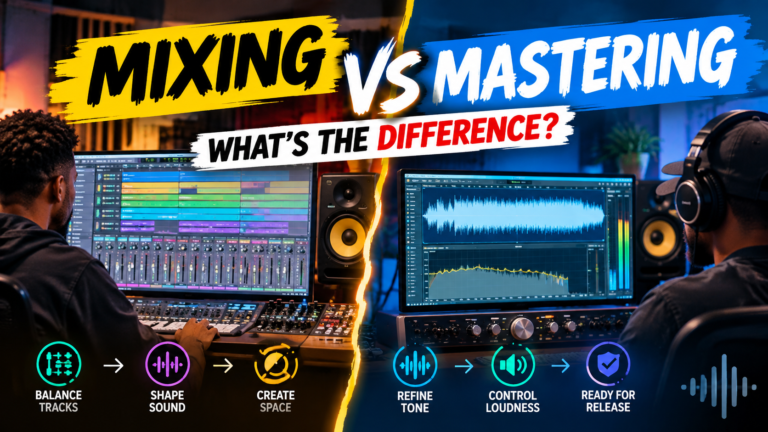
The mixing engineer takes the recorded elements and balances them into a cohesive mix, working with levels, tone, dynamics, effects, stereo image and other aspects of the final mix. The Recording Academy distinguishes the recording engineer, mix engineer and mastering engineer as separate roles within the broader engineering process.
So an artist could potentially work with:
Artist → Producer → Recording Engineer → Mixing Engineer → Mastering Engineer
Or, in a smaller independent workflow:
Artist + Producer/Engineer → Finished Song
Neither workflow is automatically better. It depends on the project, budget, experience of the team and desired result.
A Realistic Studio Example
Imagine an independent artist from Aba comes into the studio with a WhatsApp voice note, a beat and a rough chorus.
The artist says:
“I know the song is good, but I don’t know what is missing.”
This is not simply a recording problem.
A recording engineer can certainly record the material well, but the bigger issue is creative development.
A producer may discover that the chorus needs stronger harmonies, the verse needs fewer words, the intro is too long and the final hook needs a bigger vocal arrangement.
The recording engineer then makes sure those newly developed performances are captured properly.
Now consider another artist.
This artist arrives with a completed instrumental, rehearsed lyrics, a detailed vocal arrangement and a clear reference for the intended sound.
They do not need someone to redesign the song.
They need an engineer who can capture the performance accurately and efficiently.
That artist may get more value from spending the budget on quality recording, editing and mixing rather than adding another creative role they do not need.
The Biggest Mistake Artists Make
One of the most common mistakes is assuming that better equipment will solve a creative problem.
It usually will not.
A premium microphone cannot fix a weak melody.
A better preamp cannot fix an unfinished arrangement.
Expensive studio monitors cannot turn an unconvincing vocal performance into an emotional one.
Equipment matters, but the people making creative and technical decisions matter too.
This is why the distinction between production and engineering is important.
Before spending money on another hour in the studio, ask yourself:
Is my problem creative, performance-related or technical?
If you do not know what the song should sound like, you probably need creative guidance.
If you know exactly what you want but need it captured professionally, you may primarily need an engineer.
If the recording is already complete but the final track does not sound balanced and polished, you may actually need a mixing engineer.
CFATMUSIC Studios also provides professional mixing and mastering for projects that have already been recorded.
How Much Does a Producer Change the Song?
A producer’s value is not simply measured by how many sounds they add.
Sometimes good production means adding something.
Sometimes it means removing something.
A producer may tell an artist to sing less.
They may remove an instrument from the chorus.
They may shorten the intro.
They may change the structure.
They may ask for a completely different vocal delivery.
They may decide that the original idea is actually strong and should not be changed.
Good production is about making decisions that serve the song.
That is why two artists can use the same type of beat, work in similar studios and still produce completely different records.
What Should You Ask Before Booking a Studio?
Do not book a session based only on the words “recording studio.”
Ask what is actually included.
A professional studio should be able to explain whether your booking covers recording only, or whether it also includes editing, vocal production, arrangement assistance, mixing, mastering or other services.
You should also ask who will be working with you.
If you need production, confirm that the person assigned to the session has experience with the kind of music you are making.
Likewise, if you already have a finished record and only need recording, do not automatically pay for services you do not need.
The goal is not to hire the largest team possible.
The goal is to put the right people around the song.
Key Takeaways
A recording engineer is primarily responsible for capturing and managing the technical side of your recording session.
A music producer focuses more broadly on the creative direction of the record, including arrangement, performance, instrumentation and the overall development of the song.
You may need both, one person who can handle both roles, or just a recording engineer.
The deciding factor is your level of preparation.
If you already know what the song should be and simply need it recorded properly, an engineer may be enough.
If you have a great idea but need someone to help turn it into a stronger record, a producer can be extremely valuable.
And if you are unsure, speak with the studio before paying for the session. Explain what you have, what you want to achieve and where you feel stuck.
Final Thoughts
The question should not really be “Do I need a producer or a recording engineer?”
A better question is:
“What does my song need right now?”
If the song needs microphones, clean recording, proper session management and technically sound captures, you need engineering.
If the song needs direction, arrangement, performance coaching, musical decisions and creative development, you need production.
Sometimes one professional can provide both.
What matters most is understanding what you are paying for before the session begins.
The strongest studio experience is not necessarily the one with the most people in the room. It is the one where every person has a clear job and those responsibilities serve the music.
For artists who need a complete recording-to-release workflow, CFATMUSIC Studios provides full music production services as well as music distribution and other artist-focused services.
Your job as the artist is to bring the idea.
The right producer, engineer and creative team help turn that idea into a record people can actually hear, remember and connect with.
References
Berklee College of Music — Music Producer and Recording Engineer career guides.
The Recording Academy / GRAMMY GO — Guides to music producers and sound engineers.
The Recording Academy Producers & Engineers Wing — Technical guidelines and professional role definitions.