
Table of Contents
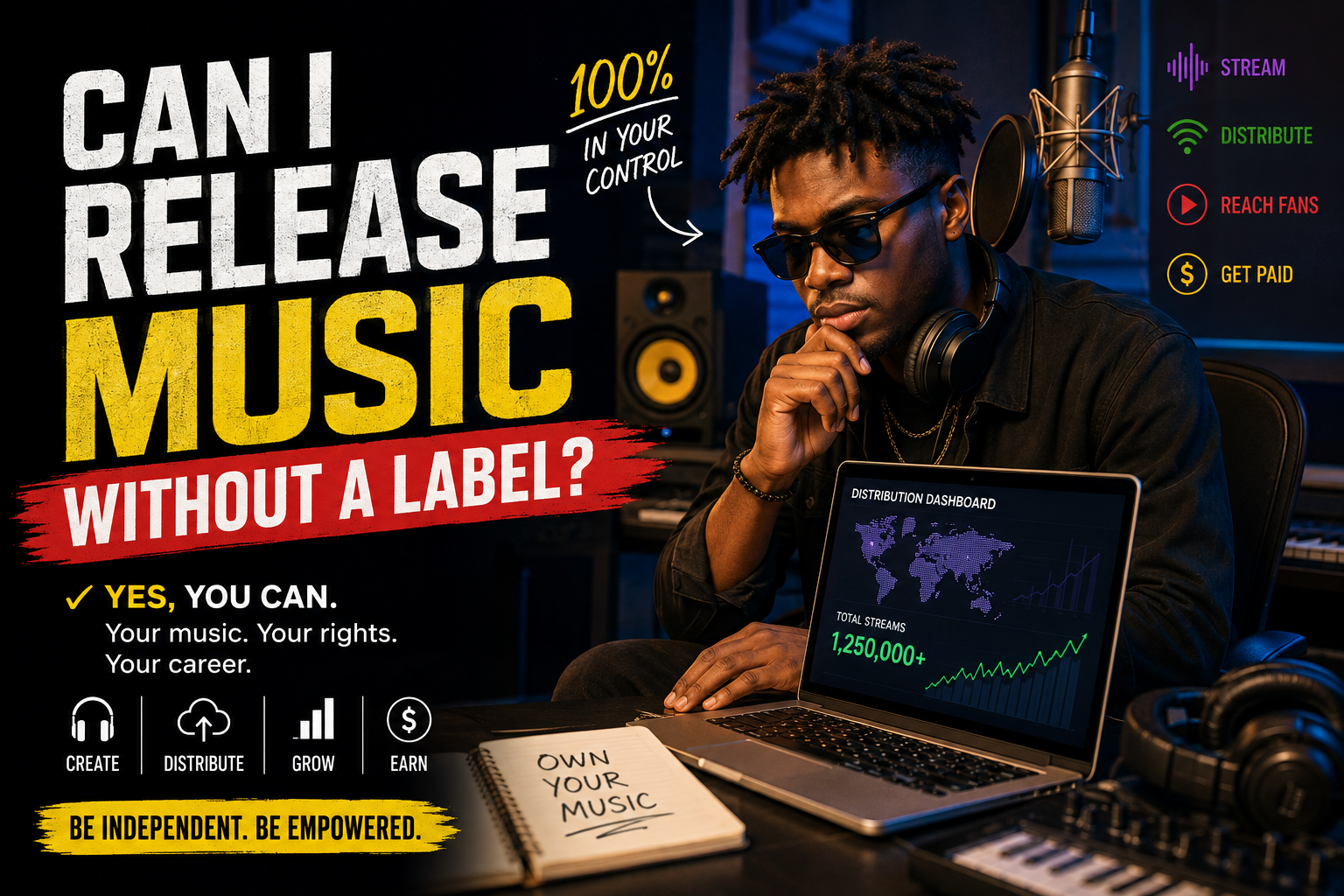
Yes, you can release music without a record label.
In fact, independent artists can now record, distribute, promote, monetize, and build audiences around their music without signing a traditional record deal. The modern music business gives artists access to digital distributors, streaming platforms, social media, analytics, marketing tools, and direct-to-fan channels that were once difficult to access without industry backing.
But there is an important distinction: being independent does not mean doing everything yourself.
You can remain an independent artist while paying a distributor to deliver your music to streaming platforms, hiring a producer or recording studio, working with a marketing professional, using a playlist-pitching service, or hiring a manager.
The real question is therefore not simply “Can I release music without a label?” It is:
How can I release music independently while protecting my rights, managing my money, and giving the release a realistic chance of finding an audience?
Can I release music without a label?
Yes. You do not need a traditional record label to release your music on major digital platforms.
Spotify, for example, explains that music is delivered to the platform through a distributor. Distributors handle delivery and licensing arrangements with streaming services and pay royalties to the relevant rightsholders. Spotify maintains a directory of artist distributors that includes services such as DistroKid, CD Baby, Amuse, Ditto, RouteNote and others. (Spotify for Artists)
This means an independent artist can essentially build a release team around themselves:
- Artist: creative direction and performance
- Producer: instrumental and production
- Recording engineer: recording
- Mixing/mastering engineer: audio quality
- Distributor: digital delivery
- Artist: marketing and audience development
- Manager: optional career and business management
- Publisher/collective management organization: where applicable, for certain songwriting and publishing rights
You remain independent because you have not transferred control of your career to a traditional record label.
What does a record label actually do?
Understanding this is important because many artists assume that the only function of a record label is putting songs on Spotify.
That is not the case.
A traditional label may provide some combination of:
- Recording investment
- A&R and artist development
- Marketing
- Publicity
- Distribution
- Playlist and radio promotion
- International market support
- Music-video investment
- Branding
- Partnerships
- Tour and commercial support
- Industry relationships
- Business and strategic expertise
The scale of support depends heavily on the particular label and contract.
IFPI’s 2026 Global Music Report highlights the continuing role of labels in artist development, marketing, distribution, investment and international expansion. The report also states that record companies invested billions globally in areas including A&R and marketing. (IFPI)
So the independent route does not mean “labels are unnecessary.”
It means you can decide which services you need and purchase or build them separately.
That can give you greater control, but it also means greater responsibility.
How can I release music without a label?
For most independent artists, the process looks something like this:
1. Create and finish the song
Before thinking about distribution, make sure the recording itself is ready.
That means:
- Professional recording
- Proper vocal editing
- Mixing
- Mastering
- Correct song arrangement
- Final WAV master
- Instrumental version where necessary
- Clean version where appropriate
- Acapella where useful
If you are working with a professional studio, CFATMUSIC Studios’ full music production service can cover the production process from creating the instrumental through recording and mixing.
The important point is that distribution should be the last stage of production, not a substitute for production quality.
2. Make sure you actually control the rights
This is one of the biggest areas where inexperienced independent artists make mistakes.
Before releasing a song, determine who owns what.
There can be several separate rights involved in a single recording.
For example:
Composition/songwriting:
Who wrote the lyrics, melody and musical composition?
Sound recording/master:
Who owns the finished recorded performance?
Beat/instrumental:
Was it purchased, leased, commissioned or created by someone else?
Performance:
Who performed on the recording?
Production:
What agreement exists between the producer and artist?
If three people wrote the song, they should not simply assume that everyone owns an equal percentage. The actual ownership and royalty split should be agreed upon.
Put the agreement in writing.
This becomes particularly important when a song starts generating significant income.
3. Prepare accurate metadata
Metadata may sound boring, but mistakes here can create expensive problems later.
Prepare:
- Artist name
- Song title
- Featured artists
- Songwriters
- Producers
- Copyright information
- Release date
- Genre
- Language where required
- ISRC information where applicable
- Cover artwork
- Lyrics where supported
- Explicit-content designation
- Composer information
- Publishing information
Spotify specifically instructs artists to provide release metadata, credits, release dates and cover art when uploading through a distributor. (Spotify for Artists)
Do not rush this stage.
A misspelled artist name or incorrect songwriter credit can make royalty tracking and catalog management more difficult.
Do I need a music distributor if I don’t have a label?
Usually, yes, if you want your audio release delivered to major streaming platforms such as Spotify and YouTube Music.
A distributor acts as the technical and commercial bridge between an independent artist and digital music platforms.
You provide the distributor with your music and metadata. Depending on the service, the distributor may then deliver your release to platforms, collect certain recording royalties, and provide reporting and other services.
Spotify explicitly states that music is uploaded to Spotify through a distributor. (Spotify for Artists)
YouTube similarly explains that digital aggregators distribute music to services such as YouTube and YouTube Music, handle metadata and delivery requirements, and report earnings. (Google Help)
Distributor vs record label
These two are not the same thing.
A distributor primarily helps get your music into digital stores and streaming services and may provide additional services.
A record label can invest in the artist and recordings while providing broader A&R, marketing, development, distribution and commercial support.
An independent artist can therefore have:
Artist → Distributor → Spotify/Apple Music/YouTube Music/etc.
without having:
Artist → Record Label → Distributor → Streaming Platforms
That distinction is extremely important.
How much control do independent artists have?
One of the biggest advantages of releasing music independently is control.
Depending on your agreements, you may retain control over:
- Your master recordings
- Your artist name
- Your release schedule
- Your creative direction
- Your artwork
- Your marketing strategy
- Your distributor relationship
- Your catalog
- Your collaborations
- Your revenue arrangements
However, independent does not automatically mean you own 100% of everything.
If you collaborate with a producer, songwriter, featured artist or other rightsholder, they may have contractual rights or royalty interests.
Spotify’s current royalties guidance illustrates why this distinction matters: recording royalties and publishing royalties are different revenue streams, and money can flow through different rightsholders, distributors, publishers and collective management organizations. (Spotify for Artists)
Before release, know exactly who owns the master and who owns the composition.
Can an independent artist make money from streaming?
Yes, but releasing a song does not guarantee that it will generate meaningful income.
Streaming royalties depend on factors including consumption, territory, platform economics, the rights involved and your contractual arrangements.
There is also no universal fixed amount that Spotify or another major streaming platform simply pays per stream.
Spotify explains that its royalty system is based on streamshare, rather than a fixed per-stream rate. The money is paid to rightsholders, who then distribute it according to their agreements. (Spotify for Artists)
This is why an independent artist should not build a financial plan around statements such as:
“100,000 streams equals exactly X amount of money.”
The actual amount can vary.
And streaming income is only one part of an artist’s potential revenue.
An independent artist can also earn from:
- Live performances
- Direct music sales
- Merchandise
- Publishing
- Performance royalties
- Sync licensing
- YouTube revenue
- Brand partnerships
- Features
- Beat sales
- Fan subscriptions
- Digital products
- Production services
The objective should be to build a music business, not simply chase streams.
Do I need a record label to get on Spotify?
No.
You need your music delivered through an appropriate distribution route.
Spotify’s artist onboarding guidance specifically directs artists to choose a distributor and then upload their release through that distributor. Once the music is available, artists can claim and manage their Spotify for Artists profile. (Spotify for Artists)
This is one of the biggest changes in the modern music industry.
An artist from Aba, Lagos, Port Harcourt, Enugu, Abuja or anywhere else does not necessarily need a physical relationship with a major record company to make their recording available internationally.
The harder part is no longer simply getting the song online.
The harder part is getting the right listeners to care about it.
What about YouTube if I don’t have a label?
You can operate your own artist-focused YouTube channel without being signed to a record label.
YouTube also has an Official Artist Channel system.
According to YouTube, an Official Artist Channel can bring together an artist’s music and content and provide artist-specific features and analytics. Eligibility requires, among other things, at least one official music release delivered through a distributor or label and compliance with YouTube’s policies. (Google Help)
Importantly, YouTube states that artists without a label or distributor can work with a Music Service Partner that can request an Official Artist Channel on their behalf. (Google Help)
So being independent does not prevent you from building an official presence on YouTube.
What about copyright in Nigeria?
If you are releasing music from Nigeria, copyright should be treated as part of your release strategy rather than an afterthought.
The Nigerian Copyright Commission administers copyright matters in Nigeria, and its current e-Registration system provides a mechanism for creators or rights holders to register works online. The Commission explains that copyright exists automatically when an original work is created, while registration provides evidence and documentation that can help establish ownership and creation details. (Eregistration)
Nigeria’s Copyright Act 2022 also provides the statutory framework governing copyright protection. (Copyright Office Nigeria)
For an independent artist, practical documentation is still essential.
Keep copies of:
- Original project files
- Vocal recordings
- Instrumental files
- Contracts
- Producer agreements
- Beat licenses
- Collaboration agreements
- Split sheets
- Final masters
- Artwork
- Release metadata
- Distributor statements
- Registration records where applicable
Copyright disputes become much easier to manage when you can demonstrate how a work was created and who agreed to what.
Should I release music independently or look for a label?
There is no universal answer.
The better question is:
What does the artist need right now that they cannot efficiently provide themselves?
Independent release may make sense when:
- You want maximum control.
- You have a small but growing fanbase.
- You can finance your recordings.
- You understand basic music-business administration.
- You have people who can help with marketing and production.
- You want to test your audience before pursuing a label.
- You are comfortable building gradually.
A label may make sense when:
- The label offers meaningful financial investment.
- It has demonstrated marketing capability.
- It has genuine relationships in your target markets.
- It can help you reach audiences you cannot currently reach.
- Its team has a credible track record.
- The contract is commercially reasonable.
- The rights you give up are justified by what you receive.
Do not sign a record deal simply because someone gives you a label logo, promises fame or says they can “blow” your song.
Evaluate the actual deal.
Independent does not mean doing everything alone
This is perhaps the most important lesson for new artists.
An independent artist can build a professional team without becoming an employee of a record label.
For example:
Artist
↓
Producer
↓
Recording/Mixing Engineer
↓
Distributor
↓
Streaming Platforms
while separately working with:
Marketing Specialist
Photographer/Videographer
Publicist
Manager
Publisher/CMO
Entertainment Lawyer
Not every artist needs all of these people immediately.
The team should grow according to the artist’s actual needs and revenue.
For example, a developing artist may initially need only a good producer, recording engineer, distributor and a disciplined release strategy.
As the career grows, management, publicity, legal support and other specialists can be added.
The biggest mistake independent artists make
The biggest mistake is often confusing distribution with promotion.
Getting your song onto Spotify is distribution.
Getting people to listen to it is marketing.
Those are different jobs.
A distributor can help deliver your music to platforms, but that does not automatically create an audience.
After distribution, you still need a strategy for:
- Social-media content
- Short-form video
- Music videos
- Fan engagement
- Collaborations
- Performances
- Press
- Radio where appropriate
- Playlist opportunities
- Community building
- YouTube content
- Email or direct-to-fan communication
- Consistent branding
This is why an artist should think about the release weeks before the song goes live, rather than uploading a song today and beginning promotion tomorrow.
A practical independent music release checklist
Before releasing your next song, work through this checklist.
Music
- Final master completed
- Mix professionally checked
- WAV master exported
- Instrumental version available
- Clean version created if needed
- Acapella available if required
Rights
- Master ownership confirmed
- Songwriting splits agreed
- Producer agreement completed
- Featured-artist agreement completed
- Beat license reviewed
- Samples cleared
- Copyright documentation organized
Metadata
- Correct artist name
- Correct song title
- Correct featured artist information
- Correct songwriter credits
- Correct producer credits
- Correct release date
- Correct explicit-content designation
- Artwork prepared
Distribution
- Distributor selected
- Account verified
- Release uploaded
- Metadata checked
- Release date selected
- Artist profiles claimed where possible
Spotify recommends giving yourself time to prepare your artist profile and pitch an unreleased song before release; its current guidance recommends at least seven days before release for playlist pitching and profile preparation. (Spotify for Artists)
Promotion
- Release announcement
- Short-form video content
- Cover artwork
- Behind-the-scenes material
- Music video or visualizer plan
- Social-media campaign
- Audience engagement strategy
- Post-release content schedule
Should independent artists release singles or albums?
For many developing artists, singles can be easier to manage than immediately releasing a full album.
A single gives you an opportunity to:
- Test a song.
- Study audience response.
- Create several pieces of promotional content.
- Learn what works.
- Improve your next release.
- Build a catalog over time.
That does not mean albums are obsolete.
An album can be valuable when the artist has a strong body of work and a clear reason for presenting it as a larger project.
The important thing is to avoid spending your entire budget recording twelve songs when you have not yet developed a strategy for marketing even one of them.
What should I spend money on first?
If your budget is limited, prioritize things that improve the quality and commercial readiness of the release.
A reasonable order might be:
1. Strong song
↓
2. Professional production
↓
3. Quality recording
↓
4. Mixing and mastering
↓
5. Strong visual identity
↓
6. Distribution
↓
7. Marketing and content
The exact budget will vary by artist and project.
For artists in Aba who need professional recording, CFATMUSIC Studios‘ session recording service can be part of the recording stage, while the professional mixing and mastering service can be used to prepare the final audio for release.
If you are ready for distribution, you can also explore CFATMUSIC Studios‘ music distribution service.
Can an independent artist become successful without a label?
Yes, but independence should not be confused with an easy path.
The digital music ecosystem has significantly lowered the barriers to releasing music globally. Spotify itself describes the growth of independent music as part of a broader shift in the music ecosystem, while its current royalty guidance reports substantial activity and revenue generated by independent artists and labels. (Spotify for Artists)
However, accessibility has also created competition.
Your song can be available worldwide within a short period, but thousands of other songs are competing for listeners’ attention.
Therefore, the independent artist’s competitive advantage is not simply access to distribution.
It is the ability to consistently combine:
good music + strong identity + audience development + business discipline + effective promotion.
That combination is much harder to copy.
Final answer: Can I release music without a label?
Absolutely. You can release music without a record label, distribute it internationally, build your own artist profiles, collect applicable royalties and develop a music career independently.
But independence comes with responsibility.
You have to understand your rights, choose your collaborators carefully, manage metadata, select an appropriate distributor, plan your promotion and keep proper financial and contractual records.
A label can provide money, expertise, marketing, infrastructure and industry relationships. But you do not have to surrender control simply because you need professional services.
The smarter approach for many emerging artists is to build leverage before giving away rights.
Release music. Build an audience. Learn your numbers. Develop your brand. Create a catalog. Document your ownership. Build a team.
Then, if a label approaches you later, you are negotiating from a much stronger position.
And if no label comes along, you can still continue building the career yourself.
Key takeaways
- Yes, you can release music without a label.
- A distributor can deliver your music to major streaming platforms without you signing a traditional record deal.
- A distributor is not the same thing as a record label.
- Independent artists can retain significant control over their music and career, depending on their agreements.
- Always clarify master ownership and songwriting splits before release.
- Copyright and documentation matter, particularly when multiple collaborators are involved.
- Getting music onto streaming platforms is distribution, not promotion.
- You still need a strategy for building an audience.
- You do not have to do everything alone to remain independent.
- A record deal should be evaluated based on the actual value and rights involved—not simply the prestige of being signed.
For more practical guidance on building a music career independently, visit the CFATMUSIC Studios music industry blog.
Authoritative references
- Spotify for Artists — Distribution, artist profiles and royalty guidance. (Spotify for Artists)
- YouTube — Official Artist Channels and music aggregation guidance. (Google Help)
- Nigerian Copyright Commission — Copyright registration and Nigerian copyright framework. (Eregistration)
- IFPI — Global recorded-music industry and label investment context. (IFPI)