
Table of Contents
Putting a song online is easier than ever. An artist can record a track, create artwork, upload a video to YouTube, and share the link with thousands of people within minutes.
But there is an important distinction many independent artists, producers, and even some studio owners overlook: uploading music is not the same as distributing music.
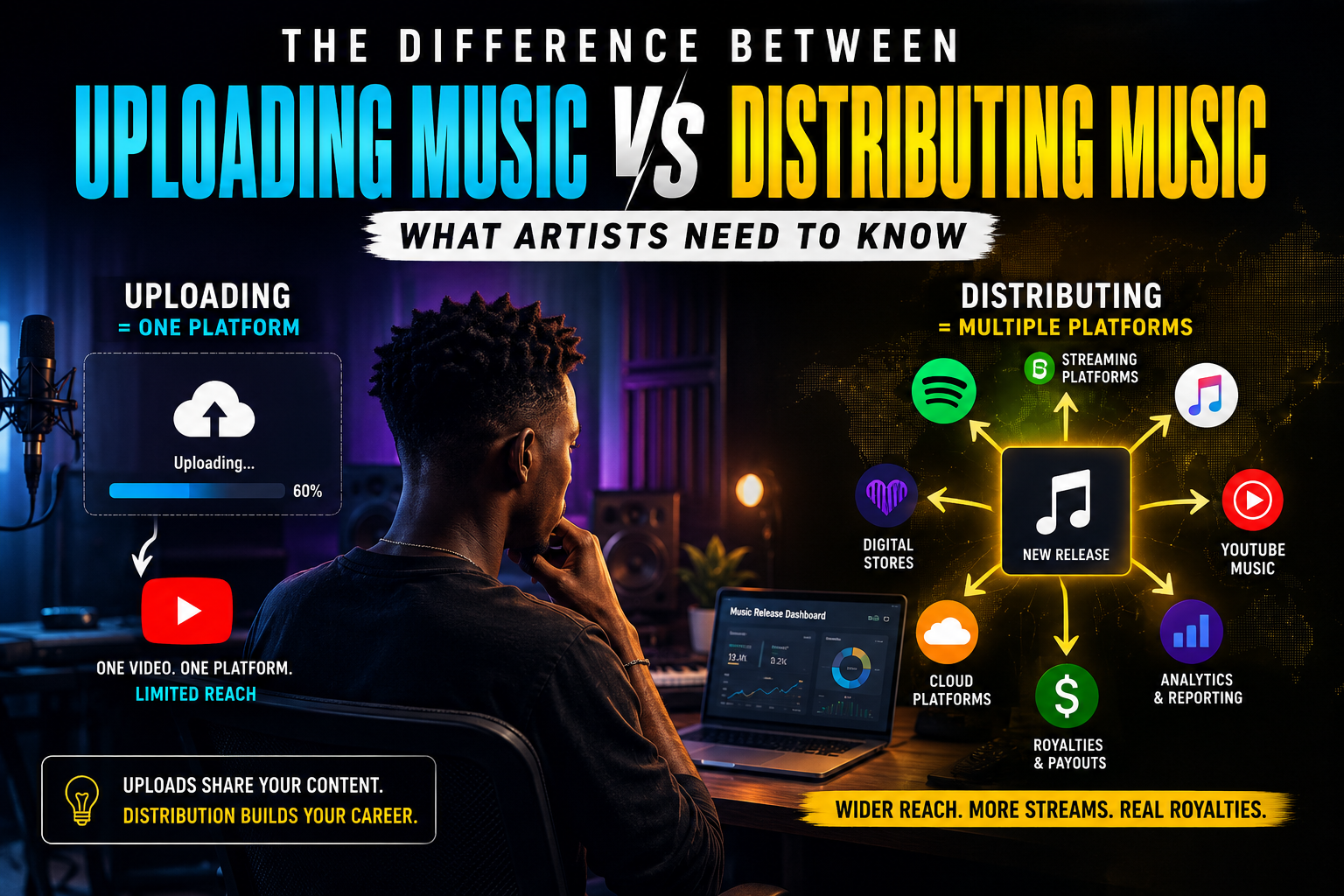
Uploading usually means placing a particular piece of content on a particular platform. Distribution is the structured process of delivering a music release to digital music services and managing the metadata, rights information, delivery, reporting, and royalty flow associated with that release.
That difference matters.
You can upload a song to YouTube and still have no official audio release on Spotify. You can post a music video on your Facebook page and still have no distribution to Apple Music. You can even upload an audio file to a platform without having properly handled the information needed for that recording to be identified and monetized across the wider digital music ecosystem.
Spotify states that artists generally work with distributors to get music onto Spotify, while YouTube explains that even artists who upload music videos to their own channels need their audio files and metadata delivered through a music aggregator or distributor for their music to be fully published on YouTube and YouTube Music. (Spotify)
So, what is the difference between uploading music and distributing music? Let’s break it down.
What Is Uploading Music?
Uploading music means transferring a music file or piece of content from your device to an online platform.
For example, when an artist uploads a song to YouTube as a visualizer, lyric video, or official music video, that is an upload.
The same principle applies when you upload:
- An MP3 or WAV file to a website
- A music video to YouTube
- A teaser to Instagram
- A song file to a cloud-storage service
- A performance video to Facebook or TikTok
- An audio file to another platform that accepts creator uploads
The defining characteristic is simple: you are putting content onto a specific platform for that platform’s users to access.
Uploading is therefore primarily a content-publishing action.
It does not automatically mean the song has been delivered to every major streaming service, registered correctly throughout the digital music supply chain, or placed into a system for centralized royalty collection and reporting.
Example: A Nigerian independent artist
Imagine an artist in Aba finishes a single called My Time.
The artist exports the final WAV file, creates a cover image, opens YouTube, uploads the song as a visualizer, and publishes it.
The song now exists on YouTube.
But the artist may still have no official release on Spotify, Apple Music, Deezer, Audiomack, or other services.
The artist has uploaded the song.
The artist has not necessarily distributed it.
What Is Music Distribution?
Music distribution is the process of delivering a properly prepared music release to digital music services, stores, and other platforms through an appropriate distribution channel.
A distributor or digital aggregator acts as an intermediary between the artist or label and participating music services.
Spotify explicitly describes distributors as the companies that handle music distribution and pay streaming royalties to artists. (Spotify)
Apple likewise explains that distributors manage the relationship between artists and streaming services such as Apple Music and the iTunes Store, including content issues and streaming, financial, and royalty information. (itunespartner.apple.com)
Distribution therefore involves considerably more than sending an audio file.
A typical release may require:
- Master audio files
- Cover artwork
- Artist and contributor information
- Song title and version information
- Release date
- Genre
- Language
- Copyright information
- ISRC information for recordings
- UPC/EAN information for releases
- Territory information
- Explicit-content information where applicable
- Composer and songwriter details
- Featured artist information
- Other required metadata
The distributor then delivers that release to supported digital platforms according to their technical and content requirements.
YouTube describes aggregators as companies that can prepare metadata to industry standards, complete DDEX deliveries, provide rights and analytics support, and report earnings. (Google Help)
Uploading Music vs. Distributing Music: The Main Difference
The easiest way to understand the difference is this:
| Uploading Music | Distributing Music |
| Puts content on a particular platform | Delivers a release through a structured distribution network |
| Usually platform-specific | Can reach multiple digital music services |
| Focuses on publishing content | Focuses on delivery, metadata, rights and catalog management |
| Can be done directly by the creator | Usually involves a distributor, label or qualified delivery partner |
| May involve a video or audio post | Normally involves a complete music release package |
| Does not automatically establish broad digital availability | Designed to make a release available across supported stores/services |
| May provide platform-specific analytics | Can provide catalog, sales, streaming and royalty reporting depending on the distributor |
The important point is that uploading and distributing are not competing versions of the same thing.
They serve different purposes.
Why Can’t an Artist Just Upload the Song Everywhere?
This is where beginners often become confused.
An artist may think:
“I’ll just create accounts on Spotify, Apple Music, YouTube Music and the other platforms and upload my song myself.”
Some platforms have creator-upload systems, but the major streaming ecosystem is not generally structured around every individual artist independently uploading every commercial release directly.
Spotify currently tells artists to work with a distributor to get their music onto Spotify and says all music must be uploaded via labels and distributors so that it is properly licensed. (Spotify)
Apple Music similarly directs independent artists and smaller labels toward distributors and explains that its distributor partners manage delivery, content information and related reporting. (Apple Music for Artists)
YouTube makes an especially useful distinction: uploading a music video to your own artist channel is not the same as having the audio and metadata properly delivered to YouTube Music. (Google Help)
That is why a release can have a YouTube video while still requiring separate digital distribution.
What Actually Happens During Music Distribution?
A professional distribution process usually begins before the song reaches a streaming service.
1. The release is prepared
The artist or label provides the final masters, artwork and release information.
At this stage, mistakes can become expensive later.
For example, entering the wrong artist name, songwriter, featured artist, release date or version title can create metadata problems that are much harder to correct after release.
2. Metadata is organized
Metadata tells music services what the recording actually is.
It can identify the artist, track, album, contributors, genre, release date, copyright information and other details.
This is one reason distribution is more than “uploading a WAV.”
Apple’s delivery requirements, for example, include structured identifiers such as ISRCs for tracks and UPC/EAN/JAN codes for products. (itunespartner.apple.com)
3. The distributor delivers the release
The distributor sends the release to the services it supports.
Depending on the distributor and package, that may include major streaming services, digital download stores, social platforms and other music destinations.
Not every distributor supports exactly the same platforms or services, so artists should always check the distributor’s current delivery list rather than assuming “everywhere” means literally every platform.
4. Platforms review and process the release
Digital services may check technical specifications, metadata, rights information, artwork and other requirements.
A release can therefore be delayed, rejected or require correction if something is wrong.
Apple notes that distributors must follow specific delivery guidelines and advises artists to contact their distributor when a release does not appear correctly. (Apple Music for Artists)
5. The release becomes available
Once accepted and processed, the music can become available on the relevant services.
The artist can then claim or manage artist profiles on services such as Spotify for Artists and Apple Music for Artists, subject to each platform’s requirements. (Spotify)
Distribution Does Not Mean Promotion
This is another major misunderstanding.
Distribution puts your music where people can listen to it. Promotion helps people discover and care about it.
You can distribute a brilliant song to 20 platforms and still have very few listeners.
Why?
Because distribution does not automatically create an audience.
A distributor may deliver your release, provide analytics, collect or report royalties, and offer additional tools depending on the service. But the artist still has to build demand through marketing, content, performances, relationships, social media, playlist strategies, press, collaborations and other legitimate promotional activities.
Spotify, for example, provides Spotify for Artists tools for managing an artist profile, understanding audience data and promoting music, while also allowing eligible unreleased music to be pitched to editorial playlist teams. (Spotify)
This distinction is important:
Distribution = availability.
Promotion = attention.
You need both, but they are not the same job.
A Real Studio Scenario
Consider an artist who records a song at a studio in Aba.
The studio finishes the vocal recording, production, mixing and mastering.
The artist receives:
- Final WAV master
- MP3
- Cover artwork
- Lyrics
- Social-media video
- Music video
The artist posts the MP3 on WhatsApp and uploads a visualizer to YouTube.
That is useful content publishing.
Now suppose the artist wants the song to appear as an official release across supported streaming services.
The release needs to go through a distribution workflow.
The distributor may require the artist to submit the master, artwork, metadata, songwriter details, artist information and other release data. The distributor then delivers the package to supported services and handles the relevant delivery and reporting relationship.
That is music distribution.
A professional studio can therefore provide recording and mixing services while a separate distribution service handles the digital release.
A studio that offers multiple services may also manage the distribution process on the artist’s behalf.
For artists in Aba, CFATMUSIC Studios provides music distribution services alongside recording, production, mixing and other music-business services.
Does Uploading to YouTube Count as Distribution?
The answer depends on what you mean by “distribution.”
In the broadest sense, uploading a video does distribute that particular piece of content to viewers on YouTube.
But in the music-industry sense, a YouTube upload is not the same as commercial digital distribution of the recording.
YouTube itself explains that artists can upload music videos to their channels while still needing the audio files and metadata delivered through an aggregator for their music to be fully published across YouTube and YouTube Music. (Google Help)
This distinction can become particularly important when an artist wants access to music-specific features, official releases, catalog management, reporting or systems associated with distributed recordings.
YouTube also requires at least one official music release delivered and distributed by a music distributor or label for certain Official Artist Channel eligibility pathways. (Google Help)
Is Music Distribution Worth It for Independent Artists?
For artists who are serious about building a long-term catalog, distribution is usually an essential part of releasing music professionally.
The economics of recorded music are increasingly tied to streaming and digital consumption. IFPI’s 2026 Global Music Report states that global recorded-music revenue reached US$31.7 billion in 2025, with streaming accounting for US$22 billion, or 69.6% of global recorded-music income. (IFPI)
That does not mean every independent artist will make significant money from streaming.
It means digital distribution is now an important part of the infrastructure through which recorded music reaches listeners.
The real question is not:
“Can I upload this song somewhere?”
The better question is:
“Have I prepared and delivered this release properly so that it can exist as part of my official music catalog?”
Common Mistakes Artists Make
Mistake 1: Thinking a YouTube upload is enough
A YouTube video can be an important promotional asset, but it should not automatically be treated as the complete digital-release strategy.
Mistake 2: Ignoring metadata
Artists sometimes focus so heavily on the audio that they treat metadata as an afterthought.
That can lead to incorrect artist pages, wrong songwriter information, duplicate releases, capitalization problems or other catalog issues.
Mistake 3: Distributing before everything is ready
It is better to prepare the master, artwork, credits and metadata carefully before submitting a release than to rush it and spend release week trying to correct mistakes.
Mistake 4: Expecting distribution to create streams
Distribution does not guarantee listeners.
Getting the song onto Spotify does not mean Spotify will automatically put it into major playlists.
Mistake 5: Choosing a distributor without checking the terms
Distributors differ in pricing, royalty structures, platform coverage, analytics, content-management tools, takedown policies and additional services.
YouTube itself advises artists to research distributors because services, pricing and royalty arrangements differ between providers. (Google Help)
Uploading, Distribution and Promotion Should Work Together
A strong release campaign usually combines all three.
Uploading gives you content to publish and share.
Distribution gets the official recording into the relevant digital music ecosystem.
Promotion creates awareness and drives listeners toward the release.
For example, an independent artist could:
- Record and professionally mix the song.
- Prepare the master, artwork and metadata.
- Distribute the official release.
- Upload an official music video or visualizer to YouTube.
- Publish short-form promotional content across social platforms.
- Claim and optimize artist profiles.
- Monitor streaming and audience data.
- Continue promoting the release after launch instead of abandoning it after the first week.
For artists who need the production side handled professionally, CFATMUSIC Studios’ full music production service and professional mixing and mastering service in Aba can form part of the pre-distribution workflow.
Artists who want to improve their broader release strategy may also benefit from artist development services in Aba and streaming optimization services.
Which One Do You Need: Uploading or Distribution?
The answer depends on your objective.
If you simply want people to watch your music video, a YouTube upload may be enough for that specific purpose.
If you want to publish an official release across music streaming and download platforms, you need a proper distribution process.
If your goal is to build a serious music career, you should think beyond both actions and build a complete release system that includes:
recording → mixing/mastering → metadata → distribution → artist profiles → promotion → analytics → catalog management.
That approach treats every song as part of an asset portfolio rather than as a one-time post.
Key Takeaways
The difference between uploading music and distributing music is mainly about scope, infrastructure and purpose.
Uploading means placing content on a platform.
Distribution means delivering a properly prepared music release to digital services through a structured delivery system.
Uploading a song to YouTube does not automatically mean the song has been distributed to Spotify and Apple Music.
Distribution also involves more than audio files. Metadata, rights information, identifiers, artwork, delivery requirements and reporting are all part of the professional process.
And perhaps most importantly, distribution is not promotion. Getting your song onto streaming platforms gives it a place to be heard; marketing gives people a reason to find it and listen.
For independent artists, understanding that difference can prevent expensive mistakes and make the entire release process much more professional.
Your song should not simply be “online.” It should be properly prepared, correctly delivered, accurately represented and supported by a strategy for reaching listeners.