
Table of Contents
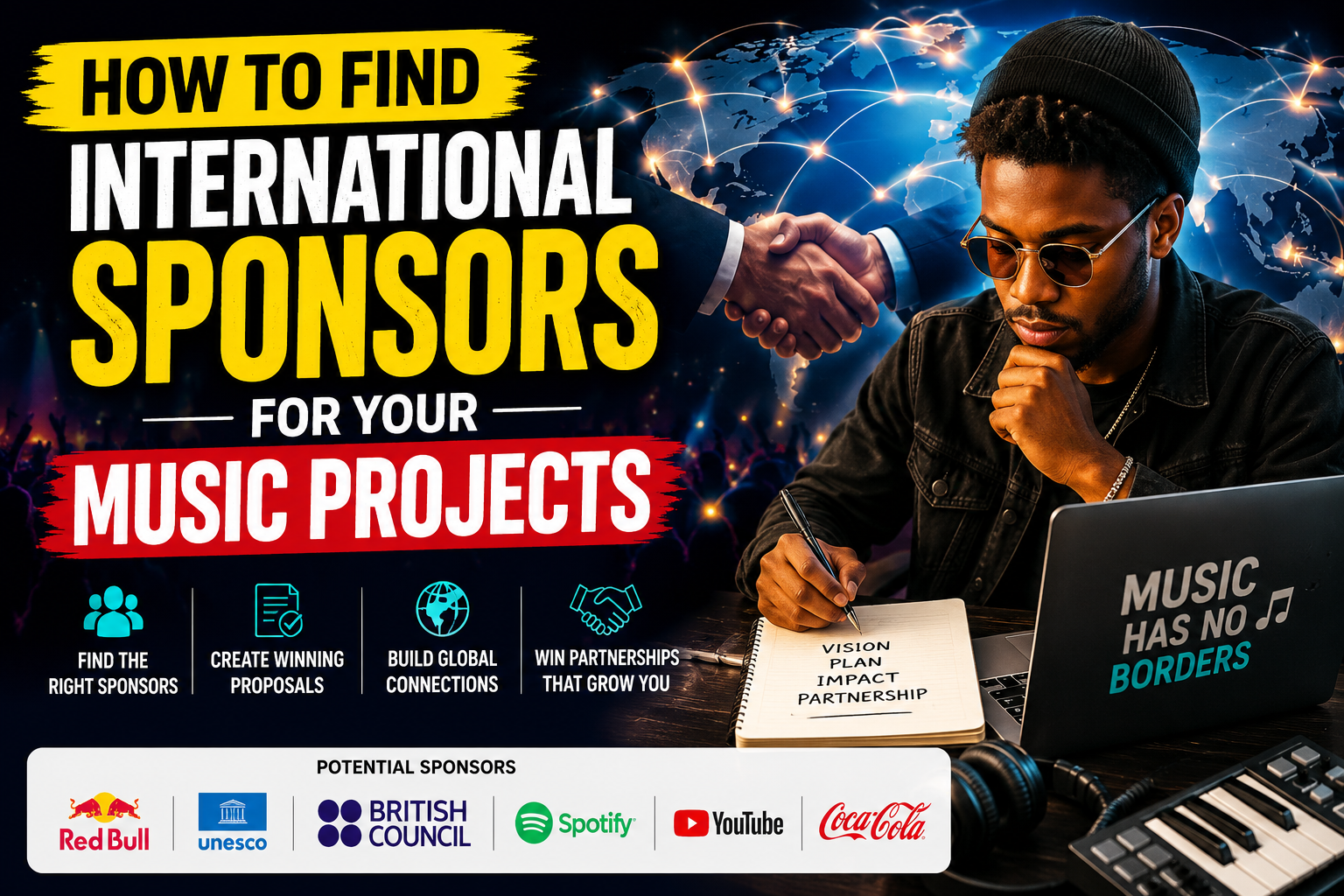
Many talented musicians never struggle because of poor music. They struggle because they cannot finance the ideas that could take their careers to the next level. They struggle because they can’t find how to find international sponsors for your music Projects.
Recording an album, producing a music video, organizing a tour, hosting a m usic festival, launching a music education initiative, or releasing a documentary all require funding. While grants remain an excellent option, sponsorship offers something equally valuable: long-term partnerships that benefit both the artist and the sponsoring organization.
The challenge is that many artists approach sponsorship the wrong way. They ask companies for money without showing what the sponsor will gain in return.
The good news is that international sponsorship is more accessible today than ever before. Digital platforms, cultural exchange programs, multinational brands, and philanthropic foundations actively support creative projects that align with their goals.
Understanding how to find international sponsors for your music projects begins with understanding what sponsors are actually looking for.
What International Sponsors Really Want
Sponsors are not charities.
Their objective is to support projects that advance specific business, social, educational, or cultural goals.
Some organizations want to promote youth development. Others focus on cultural exchange, innovation, sustainability, gender equality, education, or community development.
A music project becomes attractive when it clearly helps them achieve those objectives.
For example, a telecommunications company may sponsor a youth music festival because it increases brand visibility among young consumers. A cultural institute may support a music residency because it strengthens international artistic collaboration. A development organization may fund a community music project that promotes peacebuilding or social inclusion.
According to UNESCO (2022), the cultural and creative industries generate annual revenues exceeding US$2 trillion globally while employing nearly 50 million people worldwide, making them an increasingly important area for international investment and partnership. (https://www.unesco.org)
That growing recognition has encouraged many organizations to invest beyond traditional arts funding.
Instead of asking, “Who can fund my music?” ask a better question:
“Which organizations already invest in projects like mine?”
That simple shift changes your entire sponsorship strategy.
Build a Project That Sponsors Can Support
Many musicians make the mistake of searching for sponsors before developing a strong project.
Sponsors rarely fund vague ideas.
They fund clearly defined initiatives.
Your project should answer several important questions naturally.
What problem does it solve?
Who benefits?
Why is it important?
How many people will it reach?
What measurable outcomes will it produce?
What makes it different?
Suppose you want to organize a music workshop for underserved communities.
Instead of saying:
“We want to teach music.”
Develop a stronger proposition.
Explain how the project will provide free music education to 300 young people, create local performance opportunities, improve digital music skills, and establish mentorship relationships with professional producers.
Now your project becomes something a sponsor can confidently support.
Strong proposals combine artistic value with measurable community impact.
Where to Find International Sponsors for Your Music Projects
Finding sponsors is often easier than artists imagine because many opportunities are publicly available.
Corporate social responsibility (CSR) programs are one of the best starting points. Large multinational companies frequently support education, youth empowerment, entrepreneurship, technology, and cultural development in the regions where they operate.
Likewise, cultural institutions regularly support international artistic collaborations. Organizations such as the British Council, Goethe-Institut, Institut Français, and Pro Helvetia frequently promote cross-cultural creative initiatives through partnerships, mobility programs, and project funding. Always review each organization’s current priorities and eligibility requirements on its official website before applying.
International development agencies also support music when it contributes to broader social goals. Programs connected to education, gender equality, peacebuilding, cultural preservation, or economic empowerment may include opportunities for musicians whose work aligns with those missions.
Another valuable source is arts-focused foundations. Many private foundations fund music education, cultural preservation, artist exchanges, festivals, recording projects, and creative entrepreneurship.
Professional networking matters just as much.
International conferences, music markets, showcase festivals, cultural forums, and online networking events often connect artists directly with funders, cultural organizations, and brand representatives.
Relationships frequently open doors long before application forms do.
Create a Sponsorship Proposal That Gets Attention
A sponsorship proposal should not read like a funding request.
It should read like a partnership opportunity.
An effective proposal explains your project clearly while demonstrating the value you offer.
Sponsors typically want to understand your audience, expected reach, promotional strategy, media coverage, partnership benefits, budget, timeline, and previous achievements.
Include practical information such as:
- Project overview
- Target audience
- Marketing and publicity plan
- Sponsorship packages
- Expected visibility for the sponsor
- Budget breakdown
- Timeline
- Team experience
- Contact information
Visual presentation matters too.
Professional branding, clean design, realistic budgets, and measurable objectives immediately increase credibility.
Avoid exaggerating your audience size or promising unrealistic publicity.
Experienced sponsors can usually recognize inflated claims.
Build Relationships Before Asking for Funding
Many successful sponsorships begin months before any proposal is submitted.
Artists who consistently engage with organizations on LinkedIn, attend industry events, participate in webinars, contribute to cultural discussions, and build genuine professional relationships often receive warmer responses than those making cold funding requests.
Networking should not feel transactional.
Instead, demonstrate genuine interest in the organization’s work.
Read their annual reports.
Understand their mission.
Study previous projects they have supported.
Then explain why your music project aligns with those priorities.
Personalized proposals almost always outperform generic applications sent to hundreds of organizations.
Avoid the Most Common Sponsorship Mistakes
One of the biggest mistakes artists make is applying for every available opportunity without checking eligibility.
Sponsors notice when applications are poorly matched.
Another common error is focusing entirely on personal needs.
Statements such as “I need money to record my album” rarely persuade sponsors.
A stronger approach explains how the project benefits audiences, communities, partners, or cultural development.
Weak budgets also reduce credibility.
Sponsors appreciate transparent financial planning that clearly explains how funds will be used.
Poor communication can also damage opportunities.
Late responses, incomplete applications, missing documentation, and unclear project goals often lead to rejection even when the underlying idea has potential.
Persistence matters.
Few artists secure major sponsorships on their first attempt.
Each application provides valuable experience that strengthens future proposals.
Real-World Examples of Music Sponsorship and International Support
Around the world, artists regularly benefit from partnerships between cultural institutions, governments, and private organizations.
The British Council has supported numerous international cultural exchange projects through programmes that encourage collaboration between artists across different countries. These initiatives often combine artistic excellence with social impact and international partnership. (https://www.britishcouncil.org)
Likewise, Creative Europe has funded collaborative cultural projects involving music organizations across Europe, supporting mobility, audience development, innovation, and international cooperation. According to the European Commission, Creative Europe continues to invest in cross-border cultural and creative initiatives that strengthen Europe’s cultural sectors. (https://culture.ec.europa.eu)
UNESCO also supports initiatives that protect cultural diversity and strengthen creative industries worldwide through various programmes and international partnerships. (https://www.unesco.org)
These examples highlight an important lesson.
Successful projects usually extend beyond entertainment alone. They demonstrate educational, cultural, economic, or social value that aligns with the sponsor’s broader objectives.
Conclusion
Learning how to find international sponsors for your music projects is less about searching for generous organizations and more about building projects that solve meaningful problems while creating value for partners.
Start by defining a clear project with measurable outcomes. Research organizations whose priorities match your goals instead of sending generic applications. Develop a professional sponsorship proposal that emphasizes mutual benefit rather than financial need. Invest time in building genuine relationships before requesting support, and remain persistent even if early applications are unsuccessful.
International sponsorship is competitive, but it is far from impossible. Artists who combine strong planning, professional communication, realistic budgeting, and strategic networking consistently place themselves in a much stronger position to secure meaningful partnerships that can support both their current projects and their long-term creative careers.