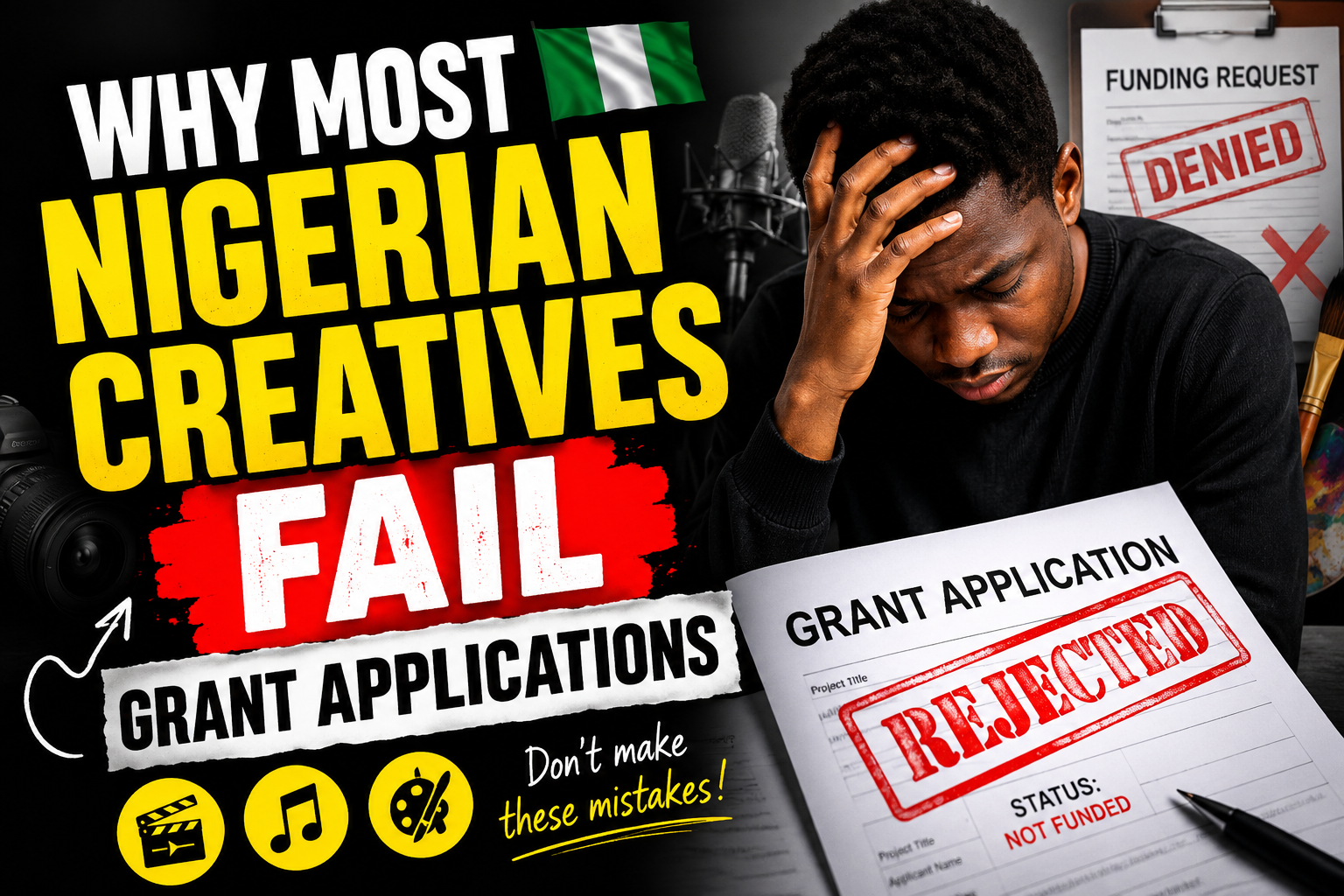

Let’s start with the truth that most people don’t want to hear: the problem is not that grants don’t exist. The real problem is that most applications are written like hopeful requests, while funders read them like investment decisions. That gap is more costly today than ever, because Nigeria’s creative economy is finally getting serious policy attention. UNESCO confirms that culture and creativity account for 3.1% of global GDP and 6.2% of all employment worldwide — which is exactly why governments and donors are now treating the sector as an economic engine, not just entertainment. In Nigeria, the Federal Ministry of Arts, Culture, Tourism and Creative Economy was established in 2023, and UNESCO noted in 2024 that the country needed stronger institutional skills, intellectual property planning, and administrative capacity to manage the sector effectively. By 2025, the Federal Government had also launched the Creative Economy Development Fund, offering debt, equity, and grant support to creative businesses. (1)
But here is the catch: the size of the opportunity can easily hide the size of the problem. Across Africa’s film and audiovisual industries, UNESCO reported in 2023 that the sector employed about 5 million people and generated roughly US$5 billion in GDP — yet the same report flagged that the continent had only one cinema screen for every 787,402 people, and piracy was erasing anywhere between 50% and over 75% of potential revenue. That is the landscape Nigerian creatives are applying into: a market full of energy, but also one shaped by weak systems, uneven infrastructure, and very little tolerance for vague proposals. Grants are not simply rejecting talent. More often, they are rejecting weak packaging, weak proof, and weak business logic. (2)
Where Nigerian Creatives Usually Lose the Application
The first place many applicants stumble is capacity — and this is more common than people admit. In a 2026 Candid survey of nearly 4,000 nonprofits, 9% had not applied for any foundation grants during the study period, and more than half of those non-applicants said the reason was simply a lack of capacity. Many also admitted they did not know how to apply. That study was not specifically about Nigerian creatives, but the pattern maps directly onto the creative world: too few people, too little time, and too little grant literacy. In plain terms, the artist, producer, designer, or founder is often trying to create, manage, market, budget, and apply all at once. When that happens, the application becomes an afterthought rather than the strategic document it needs to be. (3)
What makes this worse is that many applications are rejected before the funder even reaches the idea itself. Candid’s 2026 guidance points out that a surprising number of proposals are dropped for missing basic requirements — and that simple errors like word-count violations or ignoring video limits can trigger automatic disqualification. This matters especially in Nigeria, where many creatives still treat grant calls like open invitations rather than tightly controlled competitions. When a funder asks for a 300-word answer, a two-minute video, a legally registered business, or proof of prior work, the reviewer is not judging artistic beauty first. They are checking discipline, compliance, and readiness. A brilliant idea that ignores the rules still looks risky from the funder’s desk. (4)
Then there is the budget — and most applicants underestimate how closely reviewers study it. According to Candid, many funders read the budget before anything else, because it quickly reveals both credibility and impact. The budget is not just numbers; it is a test of whether you truly understand your own project. If the figures don’t add up, if a major cost is missing, or if the budget tells a different story from your narrative, the reviewer begins to doubt the entire application. That is one of the most common ways Nigerian creatives lose out even when their idea sounds compelling in conversation. A proposal that says one thing while the budget says another creates confusion — and funders do not fund confusion, because confusion looks like weak planning. (5)
Another critical weak spot is the failure to align with what the funder actually cares about. Candid’s 2026 guidance is direct on this: strong grant applications demonstrate alignment, make the problem easy to understand, and show exactly why the applicant is well-positioned to deliver results. That sounds straightforward, but many Nigerian creatives write from the heart instead of writing for the reviewer. They explain what they need, but not why now, why them, why this amount, and why this specific approach. They describe passion, but not the logic of impact. They talk about dreams, but not measurable outcomes. A grant reviewer is looking for a project that can be tracked, measured, and reported on — not just admired. (6)
What the Market Keeps Telling Creatives
Here is another hard truth worth sitting with: many Nigerian creatives are not failing because the market is uninterested. They are failing because the market still does not fully know how to value creative assets. The World Bank has consistently noted that creative and digital enterprises are often constrained by intangible assets, which makes traditional collateral rules feel unfair and restrictive. In the Nigeria Digital Economy Diagnostic Report, the Bank said digital entrepreneurs face limited early-stage financing, a lack of digital skills, cumbersome processes, and assets that cannot easily be pledged as collateral. That same logic applies to music catalogues, scripts, designs, films, and content libraries — assets that may be genuinely valuable, but not in the form a bank or many funders expect. In other words, too many creatives are still being judged by financial rules that were built for warehouses, not for intellectual property. (7)
The gaming sector keeps saying this in different ways. A 2025 Guardian report on Nigerian game studios revealed that developers struggled to secure funding, with one founder noting that investors often view intellectual property as high risk. That story matters because it captures a deeper psychology around creative funding in Nigeria. When a sector is young, institutions tend to trust physical assets more than creative value. So the applicant walks in with a strong portfolio but no land title, no heavy equipment, and no long credit history — and the funder sees risk where the creator sees promise. That mismatch is one of the deepest reasons grant applications fail. (8)
You can see this tension clearly in the career story of Nigerian dancer and entrepreneur Kaffy. In 2025, she told Premium Times that her new creative venture was designed to address what she called “longstanding structural gaps” in Nigeria’s creative industry, and that the business infrastructure needed for creatives to scale is often simply missing. She also shared that more than 80% of her brand development had been funded from her own personal resources, while banks initially dismissed dance as a viable business. That is not just a personal story — it is a map of the problem. A creative may have talent, reputation, and a real audience, yet still be forced to self-fund for years because institutions do not understand the business model. When grant writers ignore that reality, they end up writing proposals that sound artistic but fail to prove commercial logic. (9)
The same message surfaced in fashion in 2025. Nigerian fashion veteran Balogun Olamilekan told Premium Times that the industry needed “genuine support” to move from survival to global dominance, and he questioned whether repeated funding announcements were actually reaching the right people. He called for transparent backing through loans, grants, incentives, and training. His point cuts to the heart of the issue: many creatives assume that failing to get a grant means the market has no money. More often, it means the money is looking for structure, accountability, and a clear delivery path. A fund may exist, but if the sector cannot show how that money will translate into measurable growth, the application still loses. (10)
Why Strong Applications Look Different
Here is the encouraging part: the current funding environment is beginning to reward better structure, and that opens a real door for prepared applicants. The Creative Economy Development Fund, launched by the Federal Government in 2025, is designed to support creative businesses through debt, equity, grants, and capacity building. The Youth Initiative’s guidance advises applicants to clearly define their intellectual property, present a solid business model, estimate the value of that IP, and choose the right type of funding. The Ministry also confirmed that the fund uses IP-backed financing, meaning applicants do not always need traditional collateral. That is a significant shift — because it means your application is no longer only about pleading for support. It is about showing that you own something bankable, that you understand your market, and that you can use the funding to grow in a measurable way. (11)
With that in mind, the best applications read like small business cases, not emotional letters. They explain the problem in one clear paragraph, identify the audience or customer, describe the creative product, and connect the requested amount to a measurable result. Candid’s 2026 guidance reinforces this: strong proposals make it easy to understand the problem, the solution, and the applicant’s readiness to deliver. That is exactly the clarity Nigerian creatives need to build into every submission. For example, a music producer should not just say they need money for a project. They should explain the catalogue, the target listeners, the distribution plan, the revenue path, the timeline, and what success will look like six months after the funding lands. That is the difference between a wish and a fundable plan. (12)
At the sector level, the film industry makes this concrete. UNESCO reports that Nigeria produces around 2,500 films a year — yet Africa remains deeply underserved in cinemas, and only 19 of 54 African countries offer any financial support to filmmakers. The problem is not creativity in the abstract; it is conversion. The industry produces volume, but too little of that volume is packaged in a way that attracts patient capital, distribution support, or grant funding. In practical terms, a film funding applicant must show how their project can survive piracy, weak exhibition infrastructure, internet limitations, and fragmented audiences. The application must answer one core question: how will this work in a difficult market, and why should the funder believe it will? (13)
Another marker of a strong application is being realistic about partial funding, reporting, and follow-through. Candid’s insider guidance says funders often want to know what happens if they can only support part of a request — and they actively value applicants who are prepared for that conversation. They also look for punctual reporting, honesty about setbacks, and a budget that stays consistent with the narrative. These may sound like administrative habits, but they are really trust habits. In a sector where many creatives still operate informally, the applicant who submits clean records, clear milestones, and honest progress updates stands out immediately. That person doesn’t just look talented. They look safe to back. (14)
The Practical Way Forward for Nigerian Creatives
So here is the simple, honest takeaway: Nigerian creatives most often fail grant applications when they submit art without enough structure, or vision without enough evidence. UNESCO has said Nigeria needs stronger intellectual property systems and administrative capacity for the creative economy, and the World Bank has shown that creative firms are hurt by weak financing models, limited data, and assets that are difficult to use as collateral. Those are not excuses — they are real conditions. And a serious applicant works around them by building a file that is complete, credible, and easy to assess. That file should demonstrate ownership, audience, numbers, timing, and delivery capacity. It should also make clear that you are not asking for charity — you are asking for investment in a project that can be tracked and measured. (15)
Ultimately, the winning habit comes down to preparation. Read the criteria slowly and carefully. Answer exactly what was asked — nothing more, nothing less. Make your budget logical and honest. Keep your proposal short and concrete. And explain, in plain terms, why your work can produce measurable value in the real world. Tie your project to a real market, not just to personal ambition. Show what you already have, what you are asking for, and what the funding will unlock. Then proofread until every number, date, and attachment is clean and accounted for. That is how a creative stops sounding like a dreamer and starts sounding like a professional. In today’s Nigeria, that shift is often the only difference between rejection and a funded first step. (16)