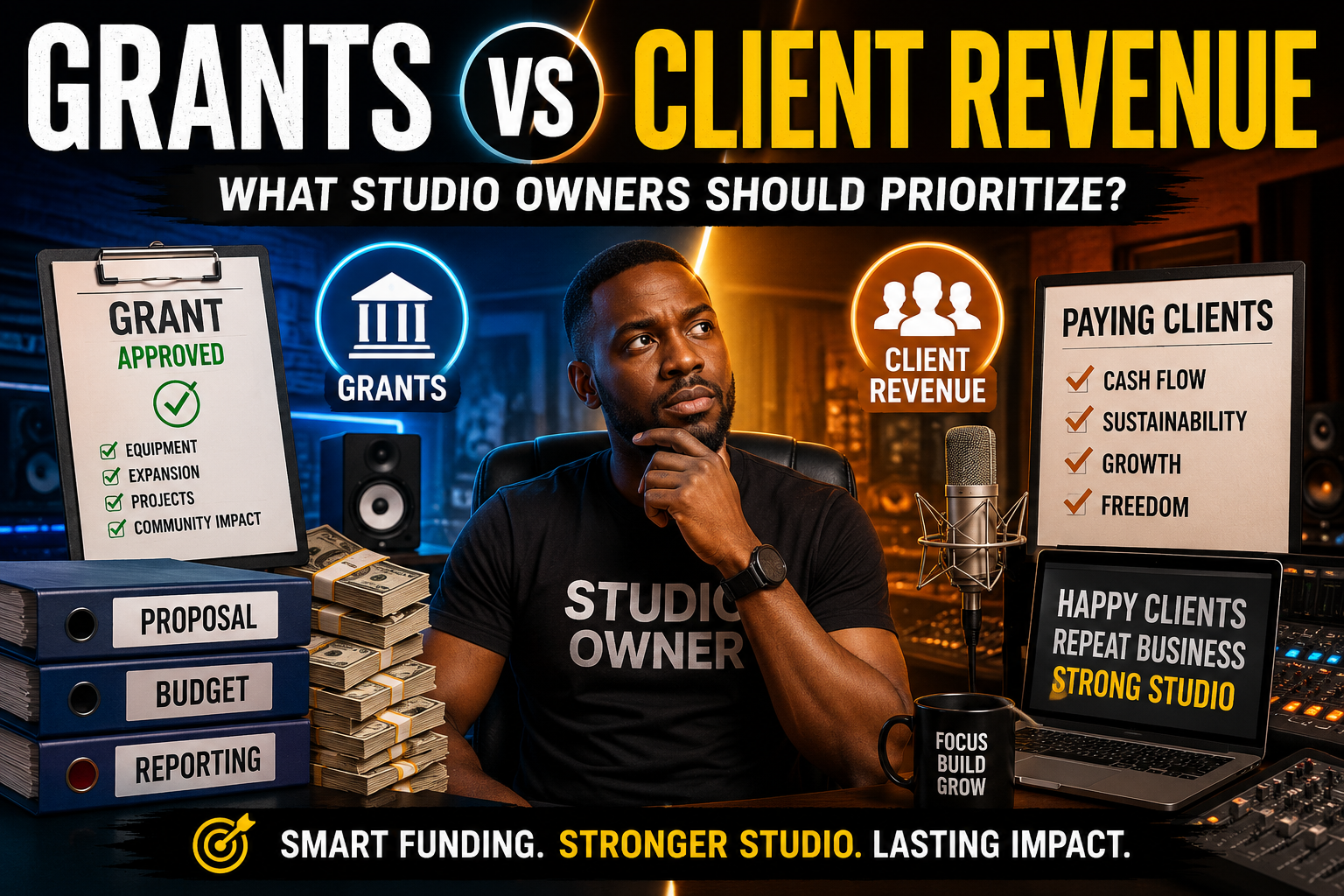

Many recording studio owners dream of securing a grant that pays for new equipment, expands their facilities, or funds ambitious creative projects. At the same time, every studio depends on paying clients to keep the lights on, staff employed, and operations running. This raises an important business question: should studio owners spend more time chasing grants or focus almost entirely on growing client revenue? Hence, Grants vs Client Revenue.
The answer is not as simple as choosing one over the other. Grants and client income serve different purposes, and understanding the difference can determine whether a studio grows steadily or struggles with cash flow despite occasional funding wins.
Successful studios around the world rarely rely on a single source of income. Instead, they build businesses where paying customers create financial stability while grants accelerate expansion. Studio owners who understand this balance are usually better prepared for economic downturns, changing music trends, and unexpected business expenses.
Whether you operate a commercial recording studio, a production company, or a creative hub, understanding where your priorities should lie is essential for long-term success.
Understanding the Difference Between Grants and Client Revenue
The debate around Grants vs Client Revenue begins with understanding what each actually provides.
Client revenue is earned income. It comes from recording sessions, music production, mixing, mastering, artist development, podcast production, music lessons, content creation, licensing, and other services. Every satisfied customer contributes directly to the sustainability of the business.
Grants are entirely different.
A grant is financial support provided by governments, foundations, development agencies, corporations, or cultural organizations to achieve specific objectives. Unlike loans, grants usually do not require repayment, but they almost always come with strict eligibility requirements, reporting obligations, timelines, and measurable outcomes.
According to the European Commission, creative grants are designed to support innovation, cultural development, and economic growth rather than replace commercial income (https://culture.ec.europa.eu).
Similarly, many arts funding organizations expect applicants to demonstrate that their businesses are already active and capable of sustaining projects beyond the grant period.
This distinction is important.
Client revenue keeps the business alive today.
Grants help finance tomorrow’s opportunities.
Confusing these two purposes often leads studio owners to invest excessive time applying for funding while neglecting marketing, customer service, and sales.
Why Client Revenue Should Remain the Primary Priority
Every healthy business needs predictable cash flow.
Recording studios have ongoing expenses regardless of whether grants are available. Equipment maintenance, software subscriptions, electricity, internet services, staff salaries, rent, insurance, and taxes continue every month.
Client revenue pays these bills.
According to the U.S. Small Business Administration, consistent cash flow is one of the most important indicators of business health because it enables companies to meet operating expenses and invest in growth (https://www.sba.gov).
For studio owners, reliable clients create several advantages beyond immediate income.
Regular customers generate referrals.
They leave testimonials.
They improve online reviews.
They strengthen the studio’s reputation.
They often purchase additional services over time.
A single satisfied artist may return for multiple singles, an EP, an album, music videos, distribution support, live session recordings, and future collaborations.
That lifetime value is difficult for any grant to replace.
Client revenue also provides freedom.
A studio funded primarily through customers can choose its own direction instead of designing projects around grant requirements.
This flexibility allows owners to respond quickly to changing market demands, introduce new services, adjust pricing, and experiment with innovative business models without waiting for funding approval.
Where Grants Can Create Exceptional Value
This does not mean grants should be ignored.
Far from it.
Strategically used grants can dramatically accelerate growth.
Many successful creative businesses use grant funding to purchase expensive equipment, renovate facilities, launch training programmes, support underserved communities, digitize operations, or expand internationally.
According to UNESCO, public investment in creative industries contributes to cultural diversity, employment, and sustainable economic development when combined with strong business practices (https://www.unesco.org).
The key phrase is “combined with.”
Grants work best when they complement an already functioning business.
For example, a recording studio generating stable monthly income may use a grant to build a Dolby Atmos mixing room, establish an artist incubation programme, purchase accessible recording equipment for people with disabilities, or launch educational workshops for young producers.
In these situations, the grant creates opportunities that ordinary operating revenue might not immediately support.
However, problems arise when studios begin depending on grants for basic operational survival.
Grant cycles eventually end.
Funding priorities change.
Governments adjust budgets.
Economic conditions shift.
A business that cannot survive without continuous grants becomes extremely vulnerable.
The Hidden Cost of Chasing Every Grant
Grant applications require significant investment.
Owners often underestimate the time involved.
Researching eligibility, writing proposals, preparing financial documents, collecting supporting evidence, creating budgets, obtaining recommendation letters, and completing monitoring reports can consume dozens of hours.
According to the National Endowment for the Arts, successful grant applications require clear planning, measurable outcomes, realistic budgets, and organizational readiness (https://www.arts.gov).
That means every hour spent writing proposals is an hour not spent acquiring new clients, improving customer experience, creating content, networking, or developing new services.
Opportunity cost matters.
Some studio owners become trapped in a cycle of constantly searching for the next funding opportunity instead of improving the commercial side of their business.
Ironically, many grant providers actually favour applicants with proven financial sustainability.
Strong client revenue often strengthens future grant applications because it demonstrates demand, responsible management, and long-term viability.
In other words, building a profitable studio today may increase your chances of receiving grants tomorrow.
A Smarter Funding Strategy for Modern Recording Studios
Rather than viewing Grants vs Client Revenue as competing options, studio owners should think in terms of financial balance.
The foundation should always be recurring commercial income.
This can come from recording sessions, production packages, podcast services, rehearsal spaces, music lessons, artist coaching, live recording, distribution support, mixing subscriptions, or membership programmes.
Once that foundation exists, grants become growth capital instead of survival money.
A practical framework is simple.
Use client revenue to pay operating expenses.
Use retained profits to strengthen financial stability.
Use grants to finance expansion projects that would otherwise take years to achieve.
This approach reduces financial risk while creating multiple pathways for growth.
Diversification also improves resilience.
If client demand slows temporarily, other revenue sources provide stability.
If grant opportunities become scarce, the business continues operating normally because paying customers remain the primary engine.
This mindset reflects how many successful creative businesses operate across music, film, gaming, and digital media.
Preparing Your Studio for Both Success and Funding
Studios that attract both customers and grants usually share similar characteristics.
They maintain professional financial records.
They understand their market.
They can demonstrate measurable impact.
They invest in branding.
They document successful projects.
They collect testimonials.
They build partnerships.
Most importantly, they solve real problems.
For example, a studio that trains young producers, supports local artists, preserves cultural music, creates employment, or improves access to creative education often presents a stronger case to funding organizations than one simply requesting equipment.
At the same time, these activities can also strengthen the studio’s reputation among paying clients.
The two goals reinforce each other rather than compete.
Building a trustworthy business also makes conversations with investors, banks, sponsors, and corporate partners much easier because financial records and operational systems are already in place.
Conclusion
The discussion around Grants vs Client Revenue should never be framed as an either-or decision.
Client revenue deserves first priority because it creates sustainability, predictable cash flow, operational independence, and long-term resilience. Every successful recording studio needs customers who willingly pay for valuable services.
Grants, however, remain powerful tools for accelerating growth, funding innovation, expanding community impact, and reaching ambitious goals that ordinary revenue may not immediately support.
The strongest studios understand this distinction.
They build profitable businesses first.
Then they use grants strategically to move faster, serve more people, and create opportunities that benefit both the business and the wider creative community.
If you are planning your studio’s future, begin by strengthening your client acquisition systems, improving service quality, and diversifying commercial income. Once that foundation is secure, develop grant-ready projects that align with your long-term vision rather than your short-term survival.
That balanced approach offers the best chance of building a recording studio that thrives for years instead of simply surviving from one funding opportunity to the next.